Showing posts sorted by date for query croucher. Sort by relevance Show all posts

Jan 25, 2010

Tank Crash

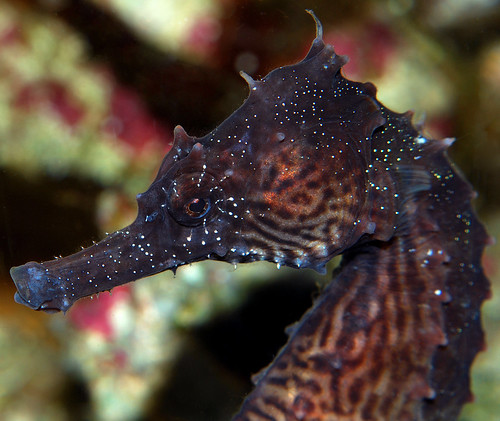
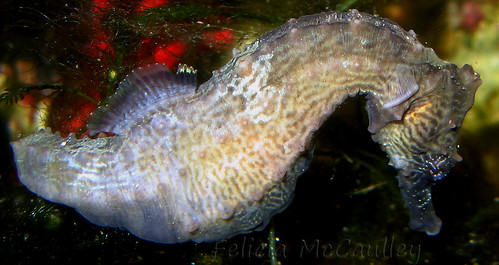
I've been putting off writing this blog for a few weeks. I experienced my worst aquarium nightmare over Christmas break. We were traveling a lot to visit relatives, and I wasn't giving my aquariums as much attention as I should have. We're not sure what caused the crash, but one day when I came home, I knew immediately something was terribly wrong. Three out of five of my seahorses were laying dead on the floor of the tank, and the fish that were left were breathing hard, discolored, and obviously stressed. I was quick to blame it on my sea cucumber, Pentacta anceps, but I'm not certain. I estimate that whatever disaster struck, happened right before I came home that day. The fish that died looked as though they had just died, and the ammonia was still at zero ppm.

We quickly did a 50% water change and put a pound of carbon in the filtration. Within a half hour, the fish that survived started to perk up. All in all, the crash could've been much worse. I lost most of my small gobies, 3 of my seahorses (Kuiter, Ellis, and Debelius), my Yellow-fin Flasher Wrasse, and my squat lobsters. All of the other inverts were fine, in fact, my Sun coral was open while all this was going on. My two seahorses Juniper and Hoover, Flashing Tilefish, and all 3 of my shrimp gobies survived (with their shrimp friends), Curious wormfish, 3 Brotulids, and Yellow Eye Anthias survived. Amazingly, one tiny red Eviota goby also survived. The Lionfish and Coral Croucher are in another tank.

I was most devastated by the loss of my seahorses. Seahorses have so much personality, they are truly pets and can't be "replaced" when they are lost. I miss Ellis, Debelius, and especially little Kuiter hitching on my fingers when I put my hand in the tank. I'll be getting a new, larger 120 gallon aquarium soon, so I'll wait to get any more seahorses until after that tank is set up and doing well.
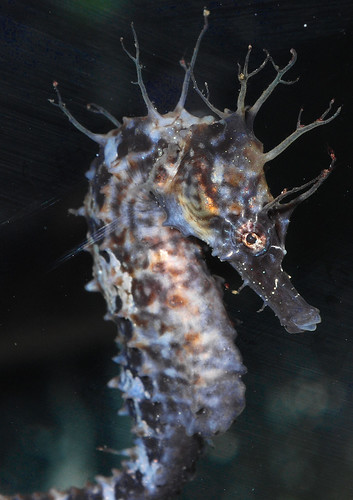
Hippocampus erectus
Kuiter

Portrait of Ellis
Ellis

seahorse erectus male
Debelius

Dec 9, 2009

Pygmy Coral Croucher

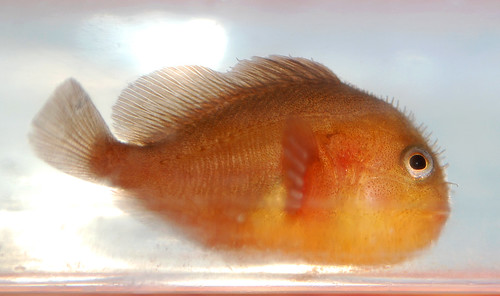
Today is an exciting day for all Caracanthus lovers! If you think Coral Crouchers are like pygmy Scorpionfish, wait till you see the Pygmy Coral Croucher. Today we found a very tiny Coral Croucher (aka Venomous Velvetfish) on an Acropora coral from Fiji. I'm pretty confident with the ID of Caracanthus unipinna because of the color and elongated tubercles. It's about the size of my thumbnail; I've never seen a Coral Croucher this tiny. It isn't spotted like the other Caracanthus, but it's pretty in its own right - the color of copper with a dark dorsal area.

Caracanthus unipinna

I've named my new acquisition "Penny" and have it acclimating into my coral tank right now. I think that will be the best place for it because there are no other fish in the coral tank, and the water quality is pristine. This tank is crawling with Amphipods and Munnid Isopods which will come in handy while I'm trying to wean this little fish onto frozen foods. I don't want to lose this tiny fish in the comparitively huge 25 gallon tank, so I bought it a little guppy breeding box. I'll keep "Penny" in there with a (somewhat) live coral frag until it is trained to eat frozen mysis and gets big enough to go into the main tank. Click here to learn more about Coral Croucher care.

I've had pretty good luck with Caracanthus in the past, and this one seems to be in good health. It really amazes me that this miniscule creature hitchhiked all the way from Fiji to my house in the middle of the U.S. continent. I'm really lucky to have the opportunity to care for and study this little known species of Caracanthus. Wish us luck!

December 18 UPDATE: Success! Penny voraciously attacked and ate a piece of frozen mysis a few minutes ago. That means I won't have to hunt for Amphipods and try to suck them up into the feeding syringe anymore. I'll keep you updated on Penny. I wonder how much bigger it will get?

November 2010 Update: Penny never got much bigger, but was eating frozen well. I decided to put it in the main tank where it disappeared. I knew there was a good chance it was still alive, but very small and cryptic. I moved my tanks recently and was sad that I didn't find it among the many other cryptic creatures I hadn't seen in over a year.

Apr 1, 2009

Caring for Caracanthus

Some of my all-time favorite fish are fish in the genus Caracanthus. There are four species in this genus, though only two are common in the pet trade -- Caracanthus maculatus from the Indo Pacific and Caracanthus madagascariensis from Africa. I've heard a few cases of a Caracanthus typicus from Hawaii in a pet shop, but I haven't yet heard of a Caracanthus unipinna  for sale (but I found one as a hitchhiker!). Some common names used are Velvetfish, Velvet Goby, or Gumdrop Coral Croucher. These fish are often called gobies, but belong to the order Scorpaeniformes like scorpionfish and waspfish. The specimens from Africa seem to be the most colorful, having pink bodies and red spots to resemble the Pocilloporid corals they inhabit.

These tiny fish only grow to about 2.5 inches max. They are clumsy swimmers and prefer to perch or squeeze themselves into tight spaces, holding on with their thick pectoral fins. Velvetfish have vertically flattened bodies so that they can squeeze into the branches of Pocillopora, Stylophora, Acropora, and similar corals. If you have large, healthy colonies of these corals in your aquarium, they shouldn't be harmed by the activities of these fish. If you keep a breeding pair, however, you may notice some tissue loss on the underside of a coral where the Velvetfish lay their eggs.

Velvetfish are venomous, so use caution when cleaning their tank. As long as you don't pick one up and squeeze it, you shouldn't get stung. The sting isn't nearly as bad as their scorpionfish relatives and feels a lot like a bee sting. If you do get stung, immediately run hot water (as hot as you can stand) over the affected area.

Velvetfish can be aggressive toward their own kind, so they are best kept singly unless you find an established pair for sale. Otherwise, they are extremely docile toward other fish. I kept my Velvetfish in a 55 gallon aquarium with many tiny gobies such as Trimma, Eviota, and clown gobies. My Velvetfish never showed aggression or interest in consuming any of my tiny gobies.

When choosing a Velvetfish for the first time, make sure to choose a fish that is not too skinny. Their bellies should be rounded and not concave. The head and dorsal area should also be full and not sunken in. Ask the pet shop to feed the fish in front of you so you are sure it is eating frozen foods. If the fish only eats live food, it might be interested in frozen food, but may only look like it's eating. So be very observant and make sure the fish actually consumes the frozen food. It takes a lot of preparation to keep a Velvetfish who only eats live shrimp and has not been trained to eat frozen food.

It can be difficult to feed these fish, especially in a larger aquarium where they have a lot of places to hide. They normally will only eat food that falls within an inch of their face, so target feeding is required.

I would recommend keeping a new Velvetfish l in a small, bare bottomed quarantine tank with one or two branching decorations for the fish to hide in. Then target feed the fish frozen food like Mysis with a syringe. There is a good chance the fish may not take to frozen food right away, even if it was eating it in the store. In this case you'll have to buy small feeder shrimps until the fish learns to eat frozen food. Freshwater ghost shrimps that have been enriched with vitamins and gut-loaded make a good live food.

Velvetfish are considered cryptic fish and tend to hide almost constantly, especially at first. Once they become comfortable in an aquarium, they can become quite tame. My Velvetfish was not afraid of me and would actually watch me and follow me as I moved around the tank. He ate directly from the tip of the feeding syringe and would even swim to it if it wasn't nearby. I find Velvetfish to be fascinating, beautiful little gems that can safely be kept in a small reef aquarium. If a non-reefer friend points out that your new Velvetfish is not very active and a little "boring," you could always impress them with, "Hey, it's venomous."

Update: https://reefs.com/2017/02/23/caracanthus-nano-scorpion/