May 27, 2009

Squat Lobster and Crinoid Update

It's been a while since I've had a squat lobster-Crinoid update. The Crinoid feather star is still doing well; it is extending its arms farther and more often now. So far I haven't noticed any deterioration of the arms, even with the squat lobster living on it.

The squat lobster is also doing very well. If a squat lobster could be happy, I would say this one is quite content. The photo above shows the squat lobster, named "Darth Vader," eating the Mysis shrimp prize it found in one of the arms of its feather star.

Commensal Coral Hermit Crab

Coral Hermit

I've acquired a new piece of coral with some interesting critters living inside. This piece is from Australia, I believe it is a Leptastrea pruinosa. The first thing I noticed about this tiny piece was the yellow commensal coral hermit crab, Paguritta sp. It measures about 3 mm total length. It is officially the smallest pet I've ever had. It is more yellow in real life, I'm still learning how to use this new camera. I've seen bigger ones, so I'm hoping it gets a lot of plankton to eat in my aquarium and grows. What really surprised me about this crab was that it was living in a Leptastrea coral. I've only ever seen them on SPS corals like Acropora, Montipora, and Astreopora corals.

I'm not sure how difficult these are to keep in captivity. Technically, these are filter feeders. If you click on the photo to enlarge it, you can see that the crab has feathery antennae that it uses to capture suspended plankton. Like its shelled hermit crab cousins, I've also seen it pick up tiny particles with its claws and put them in its mouth. Hopefully that means they will be easier to feed than other filter feeding animals.

When I looked closer at this coral, I noticed some tiny blue things with black markings. They are about half the size of the hermit crab. At first I thought they could be a different species of commensal coral hermit crab, but they didn't appear to have claws. I watched them during acclimation, but they didn't move much. Once I put the coral into my aquarium, I saw that the blue things lifted up and the tiny, feathery hand-like feeding apparatus of a barnacle came out of each one. There appears to be some tissue loss on this end of the coral, but I don't think it is a direct result of the barnacles living there. Click on the photos for larger views.

Update 6/20: I'm happy to say that my commensal coral hermit crab is doing well and is easy to feed. I target feed it daily with small pieces of frozen Mysis, Cyclops, and krill. Just like its shelled cousins, it holds the food (often several times the size of its body) in its claws, methodically rips small pieces off, and puts them in its mouth. It retreats when it detects movement nearby, but quickly comes out waving its arms and antennae when it senses food. I can get the tip of the syringe so close to the tiny crab that I can gently squirt pieces of food directly into its greedy claws. For good measure, I do often target some phytoplankton for its feathery antennae to catch.

May 11, 2009

Coldwater Catalina Gobies

Actinics Catalina Goby

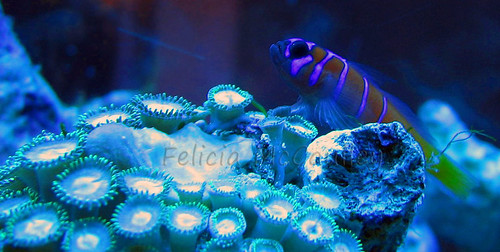
There has been a lot of focus lately on sustainable aquarium livestock harvesting and responsible aquarium keeping. The Catalina goby, Lythrypnus dalli, is notorious for being kept in inappropriate captive conditions. The picture at the left shows a captive Catalina goby perched on a sea mat "glowing" under Actinic lighting.

For years Catalina gobies were marketed as tropical fish and sold to reef aquarists. When the gobies died shortly after purchase, it was assumed that they were delicate or had short lifespans. Neither assumption is true. Catalina gobies are not tropical or sub-tropical fish. They are temperate, cold-water fish. And quite hardy, if kept in the correct environment. The maximum temperature to plan for in your home Catalina goby aquarium would be no more than 65 degrees, maintained by a chiller.

Some retailers are beginning to notice that their customers are educating themselves about the habitats of the species they are keeping, including Catalina gobies. Some of these retailers have changed their stand on Catalina gobies and other coldwater stock, admitting that they are truly temperate. But they are still recommending the incorrect temperature range. Some retailers list the maximum temperature at 74 or 72 degrees Fahrenheit. Those are still tropical temperatures. It's a step in the right direction, but their temperature recommendation is still way too high.

According to fishbase.org, the maximum water temperature Catalina Gobies can be found living in is 71 degrees. This is during the hottest point in summer in shallow water. Keep in mind that our reef fishes can be found in waters where the temperatures reach more than 90 degrees during the summer. For example, in the summer Brazilian Reidi and Erectus seahorses are observed in shallow waters where the temperature is above 90 degrees. Even the least responsible keepers would never attempt to keep their seahorses or reef fish at those temperatures. Our aquariums and captive reefs are very different from the wide open ocean. In captivity diseases and parasites can reproduce unchecked by inadequate dilution and overstocking (compared to the ocean). Attempting to keep any fish at the very top of its natural temperature range is going to shorten its lifespan and weaken the immune system. 71 degrees happens to be the top of a Catalina goby's temperature range.

Public aquariums have known for years that Catalina gobies must be kept at low temperatures. The Monterey Bay Aquarium houses Catalina gobies in a chilled aquarium maintained between 58 and 60 degrees. They are able to keep their Catalinas for an average of two years each and have no problems with disease. The Steinhart Aquarium in San Francisco keeps theirs at 60 degrees. Steve Weast keeps his Catalina gobies at 62 degrees or lower. He has graciously posted some fabulous photos of his Catalina gobies guarding eggs in this Reefcentral thread. The maximum temperature to plan for in your home Catalina goby aquarium would be no more than 65 degrees, maintained by a chiller.

I kept a beautiful pair of Catalina gobies in temperatures between 67 and 72 degrees for a few months. When I noticed their fast respiration and a Lymphocystis infection, I did some research then moved them to an aquarium with a temperature between 65 and 67 degrees. They recovered from the Lympho, but I was still only able to enjoy them for one year total.

Lythrypnus zebra

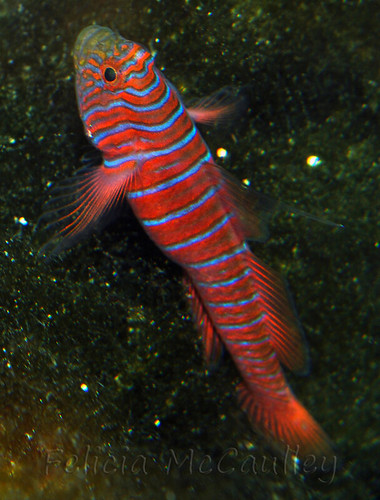
There are a few more species in the Lythrypnus genus, but only two show up in the aquarium trade with any regularity. The other is the Zebra Catalina goby, Lythrypnus zebra. This species is not often collected, and the few that make it into the aquarium trade sell quickly. Not much is known about it except that its care is similar to Catalina gobies. It has a more southern range and may be able to withstand slightly warmer water temperatures. This might make it a good candidate for sub-tropical or seahorse aquariums. I've kept one in my aquarium for nearly nine months as of this post, and it is doing very well. It is eating well, as you can see from the above photo, and hasn't shown any symptoms of disease. My aquarium temperature is between 67 and 70 degrees for most of the year, but in the summer I allow it to reach 72 or 74 degrees during the hottest weeks to prevent my chiller from prematurely wearing out. I'll update this blog if anything changes.

Trimma Goby

There are tropical gobies that rival the Catalina gobies' beauty and make much better additions to a reef aquarium. Gobies from the genus Trimma and Eviota are similar in size, color, and behavior. Trimma and Eviota gobies can even be kept in small groups with less aggression than groups of Catalina gobies.

Responsibility begins with the collectors, wholesalers, and retailers, but we as hobbyists have a voice every time we purchase a specimen for our aquarium. We can educate fellow hobbyists about cold water livestock and avoid the temptation to keep them in our tropical aquariums only to enjoy them for a few months. By avoiding difficult to keep species, we can decrease demand for these animals, and fewer of them will be collected. We all play an active role in the future of the aquarium hobby.

If you are interested in Catalina goby breeding behavior, read Sex Reversal in Pairs of Lythrypnus dalli: Behavioral and Morphological Changes and Sex allocation in a simultaneous hermaphrodite, the blue-banded goby (Lythrypnus dalli): the effects of body size and behavioral gender and the consequences for reproduction.

If you are interested in setting up a coldwater reef or temperate aquarium, more information can be found on Steve Weast's website Oregonreef.com. Wetwebmedia has a very informative section on Catalina gobies here. These photos were taken in 52 degree waters near Channel Island, California.

Update: https://reefs.com/2017/03/22/coldwater-catalina-gobies/

May 7, 2009

Nikon D60 Camera

Green Zoanthus

My new (to me) camera came in via UPS today. It is a refurbished Nikon D60 with a 18-55mm f/3.5-5.6G AF-S DX VR Nikkor Zoom Lens. I am super happy with it. Here are a few shots I took tonight with my new camera. To get this close, I used an "Opteka 52mm 10x HD² Professional Macro Lens"

Of course, you can expect more later. Click the pictures to see the full size, detailed pictures.

Duncan and snail

Caribbean blue Zoanthus


May 5, 2009

Cost of Owning an Aquarium

The first question many people ask when considering an aquarium is, "How much is this going to cost?" The total cost of an aquarium will depend on what types of animals you'll be keeping. It will also depend on the brands and models of the equipment you choose. In this blog I will try to make a loose estimation of the total cost of my aquarium and its current equipment and livestock. Keep in mind that I didn't spend all this money right away, it took a couple years to collect all of this stuff. I look for sales, shop online, and buy used equipment from local people.

I only wish that I had researched more before I bought certain things. I have an entire storage room full of aquarium equipment that I no longer use, but can't bear to throw away, because I paid for it!

Since I have two aquariums plumbed together with an overflow box, let's just consider them as one since they share all their equipment. The top aquarium is a 55 gallon "reef" tank. It has mostly photosynthetic Gorgonians, Actinodiscus sp. mushrooms, Zoanthus sp. polyps, a Turbinaria sp., Duncanopsammia sp., and other miscellaneous corals. It has about ten gobies, a pipefish, two small wrasses, and some small inverts. I bought it during a "dollar a gallon" sale at Petco a few years ago. I paid only $55.00! The lower aquarium is a 37 gallon aquarium with five seahorses, a pipefish, three Brotulids, non-photosynthetic corals like Gorgonians, several Tubastrea sp., a pink sea cucumber, and other inverts. This aquarium (along with tons of other useful stuff) was given to me by my friend Monica, but a similar aquarium would likely cost around $50.00 because it's an unusual size.

Syngnathids do best at temperatures lower than 74 degrees Fahrenheit, and two of the Brotulids I keep are sub-tropical to temperate species. Even in Wisconsin, it gets warm in the summer, so I needed a chiller. My chiller was one of my first aquarium purchases. I bought an off brand 1/10 horsepower chiller on Ebay used for a little over $300. After doing some research, I discovered that I could've gotten a similar model brand new for about the same price. I didn't make that mistake again.

I've had three different canister filters over the years, but my favorite so far has been my Fluval 405. I started with a Magnum 350, but got rid of that soon after nearly electrocuting myself. (it's a long story, but basically, the o-ring fell off into the canister after I reattached the lid, which caused water to spray out of the canister in all directions onto my power strip, which then started to smoke, prompting me to panic and push the little red switch...) My second canister filter was a Filstar XP3. I really liked this filter, but after a couple months, an air pocket developed a couple inches below the lid, and it started to leak a bit. Since the company is located in France, I didn't get much customer assistance. I later got a Fluval 405, which runs about $235.00, and haven't had a problem since. I do miss the perfectly square Filstar XP3, though. It was much easier to customize media.

I've also had several different lighting systems, but the one currently on my reef aquarium is a 48" Dual Satellite Compact Fluorescent fixture which costs about $270.00. My non-photosynthetic tank has a light, too, but just enough for me to view them. It's a single strip light, costed about $35.00. I also have a light on my refugium, a Coralife Aqualight Single Compact Fluorescent Strip Light. I got the 24" freshwater version (the color temperature is good for macroalgae) for about $70.00. I have countless ballasts, bulbs, and strip lights in my storage room that I won't factor into the ultimate cost.

I've had two different skimmers so far. I bought a Prism Pro a few years ago, but I removed it from the aquarium after a few months because it was such a pain to adjust all the time. I was constantly adjusting the water flow and air valve. After I started getting a lot of hair algae, I decided it was time for a new skimmer. I got (and blogged about) my Hydor Performer in January, and I love it. The smallest model runs about $320.00, but it is worth it.

I consider my refugium an essential part of my aquarium. It provides food for my pipefish and seahorses, helps reduce nitrates by growing macroalgae, and gives me a place to put really tiny shrimp and fish when they first come out of quarantine and I want to watch them closely. I have the the large AquaFuge External Hang-On Refugium for $165.00.

My aquarium stand was used, so I only paid about $50.00 for it. But you could expect to pay between $100 and $150 for a similar new one. I have a stand for my 37 gallon tank, but my leopard gecko tank is on it right now. It was given to me with the aquarium. It's not pretty, but I just have my seahorse tank on the kitchen floor (to the dismay of my husband).

There are other little things to factor into the total cost, like algae scrubbers, food, filter media, electricity, etc. Including electricity it costs approximately $75.00 a month maintaining my three aquariums. Luckily, my electricity is included in my rent.

I was really lucky when I bought my Live Rock. A friend of mine was moving to a different state and couldn't take her aquarium with her. She had about 50 pounds of dry rock left over and sold it to me for $50.00. Another friend placed on online order for premium branch live rock and accidentally ordered too much. He sold me 30 pounds for about a dollar a pound as well. If you are buying coralline algae encrusted live rock online, you can expect to pay around $4.75 a pound including shipping. If you buy from a local shop, expect to pay between $7.00 and $9.00 a pound, depending on where you live. You'll probably want about a pound or a pound and a half for a reef aquarium. Keep in mind that you'll be adding live rock later when you buy corals attached to rock.

I can't say for sure how much I've spent on livestock (fish, inverts, and corals) over the years, but it's likely to be my most costly category. I have a "thing" for weird and unusual fish and inverts. I estimate that I have more than $1,500 worth of livestock in my aquarium right now. That's not counting the animals and corals I've lost. You certainly don't have to spend that much on your livestock, though. You can get inexpensive, beautiful species and enjoy them just as much as the rare, expensive ones. No matter what species you get, make sure you are purchasing healthy livestock through reputable retailers that have guarantees. And if you are buying seahorses, make sure you buy True Captive Bred seahorses. They are more expensive at about $60 each (depending on the species) than Net-Pen raised and Kelloggi seahorses, but you save money in the long run on medicines and replacements.

So that's a grand total of (approximately, give me a break, I was an English major) $3,130.00. I know what you're thinking, that's a lot of money for the ugly tank pictured above. I could have easily spent $10,000 on a flashy Acropora tank, if I had the money.

Now that I've typed this all up, I am really hoping that my husband never reads this post. I am lucky because he is so supportive of my hobby. It also helps that I get a discount where I work!

May 3, 2009

Squat Lobster on Crinoid

This is the second squat lobster-Crinoid update in a week. But I just can't get over how cool symbiosis is. While I was feeding the seahorses last night, some pieces of mysis got caught in the outstretched arms of the Crinoid. The squat lobster, who was hiding at the base of the Crinoid, practically ran on the arms of the Crinoid to get the food. I wasn't fast enough with my camera, but here are some photos of him standing on the Crinoid's arms waiting for more mana from heaven.

I am tired of my point and shoot camera. It's done well for me for five years. Most of the photos on this blog were taken with a Canon A510. But I think it's time I splurged on a better camera. So, yesterday, I bought a Nikon D60. It should come in the mail by next week! I want to thank my mom for helping me; she is always supportive of me and my dreams. Most of my experience is with the Nikon brand, so I already know how to use this camera. I'll be using the lens it comes with, the 18-55mm f/3.5-5.6G AF-S DX VR Nikkor Zoom Lens. It gets good reviews for a cheap lens, but it's not a macro lens. Most of the photos I take are macro photos. The specs say it can be as close as .9 feet to the subject. I've had pretty good results from the Opteka close-up lens kits, so I bought similar ones that can screw on the front of my Nikon lens. The depth of field is really small, but it's cheaper than spending $500 on the true macro lens I really want.

May 1, 2009

Little Seahorse All Grown Up

My smallest seahorse, Debelius, has started developing a pouch. Click on the pictures to see a super close-up. The first photo is him in late March. The second photo was taken yesterday. The third is a photo of him when he was a juvenile and didn't have a pouch yet. You can see how his pouch has grown, and his chest is getting deeper. Even before he had a pouch, his chest started getting deeper than his sisters'.

seahorse erectus male

He has always been close to Ellis, the large adult female. He constantly hitches on her and stays near her. Now that he has a pouch, he is always showing it off to her. But Ellis is not impressed. She and Juniper, the large adult male, still court once every couple weeks. They've had one egg transfer so far, but Juniper lost the eggs. He had the eggs safely in his pouch after the transfer, but as soon as Ellis came near him again, he got excited, started doing pouch flushes, and pushed all the eggs out. Maybe next time they will figure it out.

If you ever find a sheet of orange eggs in your seahorse aquarium, they are probably seahorse eggs that didn't make it into the pouch. This can happen for a number of reasons. When seahorses mate, they rise to the top of the aquarium and then slowly make their way down while transferring the eggs. If the tank is not tall enough, and they are hurrying the transfer, they may not get them in the pouch. Also, if the flow in the aquarium is too strong, it will be difficult for them to make the transfer. Sometimes a female seahorse will have eggs ready, but can't find a receptive male. The eggs will not be fertilized until they are inside the male's pouch. The eggs are a nutritious food source for the other fish and inverts in your aquarium.

Apr 30, 2009

Pipefish Fossil

pipefish fossil

My husband has been collecting fossils since he was a child, and that got me interested in them, too. Of course, I care most about fossils of marine origins. We have a few little shells, Trilobites, fish, and a crab. But today I received in the mail my new favorite fossil--a pipefish fossil.

You can find some pretty nice, inexpensive fossils on Ebay. I got this beauty from Billbrand11. He estimates it is from the Ecocene Epoch, about 50 million years old or older. It was found 5 miles from Buellton, California in the Santa Ynez fault that runs through the Santa Ynez river valley; The fault runs all the way to the San Gabriel Fault. He says that 50 million years ago, there was a volcanic disturbance that caused a mass extinction of these pipefish.

The complete pipefish is about 6 inches long. The shape of the body and lack of a tail remind me so much of modern pipefish from the genus Syngnathus. They could very well be relatives. What I love about this particular fossil is that in the closeup photo of the head, you can see the the trigger pretty well; it's the triangular bump just under the eye.

I took a bunch of macro shots of this fossil, you can find the fossil album on my photobucket. I also have a bunch of fossils in my Flickr fossil set.

Apr 29, 2009

Hydor Performer Protein Skimmer

I don't think about my aquarium's equipment very often. To me, it's the most boring part of aquarium keeping. After asking other reefer's opinions, I tend to just get the best equipment I can afford and hope that its quality was worth the price.

A few months ago, I got a Hydor Performer protein skimmer. I desperately needed a skimmer because seahorses are so messy and the algae in my main tank was about to take over the world. I was not looking forward to shopping for a skimmer. I've had other protein skimmers before that I ended up removing from the tank because they were such a pain. I heard good things about these Hydor Performers, so I decided to give it a try.

From previous aquarium equipment assembly experiences, I decided to set aside an entire evening so that I could put the skimmer together. To my surprise, it took me about five minutes. I hooked it up and turned it on, spent a couple minutes adjusting the air intake, and it almost immediately started working. I had dark, rich skimmate the very next morning. I was baffled. I love this skimmer.

The only problem I did have with it was that some bubbles escaped into the tank for the first few days. But that's not really a problem, just annoying when you want to see in your tank. I also want to mention that it is a myth that seahorses get Gas Bubble Disease from skimmer bubbles in the aquarium. Having a skimmer on a seahorse aquarium can actually prevent GBD by providing cleaner water conditions and increasing oxygen.

However, sometimes a silly male will get some of these tiny air bubbles in his pouch if he is displaying too vigorously. This is not GBD, and the air usually comes out of the pouch the next time he flushes it. If he needs some help, you can gently use a bobby pin to open his pouch and very gently push on his pouch to get the air out. Of course, first decide if he is strong enough withstand the stress of being handled like that. Most of the time, it's best to let him take care of it on his own as long as he is eating well and able to get around. If anything besides air comes out of his pouch (like mucous, opaque liquid, or pus), get him into a quarantine aquarium immediately and slowly lower the temperature to 68 degrees F. Then go to the seahorse.org emergency forum and ask for help!

Apr 28, 2009

Squat Lobster Sighted on Crinoid

We had a squat lobster sighting today on the Crinoid feather star during feeding time. Sorry for the poor quality photos.

"Crinoids eat a range of microscopic particles, ranging from diatoms, foraminifera, unicellular algae, small crustaceans, larvae and detritus." from http://palaeo.gly.bris.ac.uk/Palaeofiles/Fossilgroups/Crinoidea/page2.html

I recently received an email from a Biology student working with Crinoids. He says that the squat lobsters use the Crinoids, which may be toxic, to hid from predators. Squat lobsters also steal food from the Crinoid. My squat lobsters all eat large pieces of Mysis shrimp without the help of a Crinoid. I don't think they require Crinoids for survival, because I've had my Galathea inflata since November 2007, and it has increased in size by about 25%.

I think I may have seen the squat lobster "combing" through the Crinoids feathery arms. Since it is difficult to feed these sea stars in captivity, I wonder if the squat lobster will increase its chance of starvation in my aquarium. Chuck Raabe has a little section on these squat lobsters and says they are "Klepto-parasites that don't directly harm the host but steal its food." I'll have to try to think of a way to keep the squat lobster well fed so it doesn't steal too much from the feather star. Or I could relocate the squat lobster. I don't know anyone who has kept one of these Crinoids in an aquarium for longer than six months, so if I make it past that point, I will be satisfied.

I want to make a point to say that I did not purchase this Crinoid. I do not recommend purchasing animals from your local shop that have a poor survival rate in captivity. That will just encourage your local shop to order and sell more of them. It is for the same reason I do not encourage purchasing an animal from a shop just to "rescue" it from poor conditions there. I would never attempt to keep an impossible creature like this one if it was not accidentally imported (hitchhiked) and then given to me to care for.

Also check out these lovely Crinoid commensals photos.

Check out this little cutie, he looks just like my squat lobster!
Crinoid Crab in Sulawesi - Watch more Videos at Vodpod.

Apr 26, 2009

Crinoid Feather Star

My local place found a Crinoid feather star as a hitchhiker in one of their shipments. Since I have a non-photosynthetic aquarium and dose phytoplankton, they decided my tank would be the best (local) home for it. I also think it will be interesting to see the behavior of my Crinoid squat lobster Allogalathea elegans with this Crinoid feather star. (My Galathea inflata is in the other tank to prevent squat lobster disputes...)

I've had the star for a few days now, and it is very cryptic. It hangs upside down under some of my branch rock in the exact spot where I placed it after acclimation (near the squat lobster). I'm considering getting a small lunar light so I can view it when it is most active at night. I've seen a couple arms come out during feeding time, but that's all I've seen of it. My squat lobster usually hangs out in a Gorgonian, but I haven't seen it since I put the feather star in. Maybe it's under there with the Crinoid.

To prepare for the addition of this sea star, I made sure to cover my pump intakes with fine mesh bags. I wouldn't want it getting the tips of its arms chopped off when it finds a cozy spot too close to the pump's impeller.

The other non-photosynthetic tank inhabitants are doing very well (as far as I know.) My hard tube coco worm Protula bispiralis has grown about two full inches since I got it a couple months ago! My sea cucumber Pentacta anceps still extends and "licks" its feeding arms when I dose phytoplankton. And of course, the seahorses are doing well.

I will let you all know how the Crinoid feather star does. They are notoriously impossible to keep in home aquariums and usually starve to death slowly. If you've had success with this species and kept it alive longer than 6 months, please give me some advice. Otherwise, just wish me luck.

Also, check out Echinoblog's new post about Crinoid locomotion and Charles Messing's blog about The Crinoid Feeding Mechanism.

Apr 14, 2009

Ribboned Sea Dragons and Seahorses at the Mall of America

Erectus Seahorse
For my birthday my husband took me to the Underwater Adventures aquarium in the Mall of America. We had heard that they opened a new seahorse and sea dragon exhibit on March 14th.

Pot Bellied Seahorses

The species on display at Underwater Adventure's Seahorse Kingdom are Potbelly seahorses, H. abdominalis; H. erectus; H. reidi; and Seaponies, H. fuscus. I was really impressed with the condition of these seahorses. It's rare to see such fat, healthy seahorses in a public aquarium.

Reidi Seahorses

I was very pleased that each species was kept in its own, very large aquarium. The aquariums were the new bullet-shaped aquariums that I like so much. It was a little tough to get photos through the curved acrylic, but if your subject is in front, it's easy. These seahorses had plenty of room to live and mate; their tanks were nearly floor to ceiling height. Most of the seahorses were very friendly and let me take their photos. The only ones that were shy were the H. fuscus, but that's normal for that species.

Baby seahorse eating

They are trying to breed their seahorses and have a few tanks set up for pregnant fathers and juveniles. I got a couple good shots of a cute little H. erectus in the fry raising tank.

Ribboned Sea Dragons

The main attraction were the Ribboned Sea Dragons Haliichthys taeniophorus. This species has been called pipefish by many scientists who only saw trawled, dead specimens without their cirri. Only recently have taxonomists begun to realize these are more closely related to the other two Sea Dragon species than pipefish. Seeing them alive and up close convinced me that they are in fact Sea Dragons and not pipefish. I got a lot of decent photos of the sea dragons, go to my Flickr Set to see all of them.

Ribboned Sea Dragons

I don't know why more aquariums and hobbyists aren't interested in keeping these Ribboned Seadragons. Rudie Kuiter in his essential book Seahorses Pipefish and their Relatives says, "No doubt an interesting species that has a lot of aquarium potential and should be bred for this purpose. It is more tropical than its southern relatives and therefore more suitable for many public aquariums." Kudos to Underwater Adventures for keeping this species. I noticed that there were two females and one male at the aquarium, perhaps we might see some juveniles next time we visit.

What's most famous about Underwater Adventures is their tunnel shark tank. You walk through a tunnel under 14 feet of water surrounded by sharks, rays, and huge sturgeons. There were about six divers with huge rulers trying to measure the sharks the day we were there. It was quite funny.

There are a few other miscellaneous creatures at the Underwater Adventures aquarium. They have a little petting area for kids and a giant octopus in a tank at the end. They had a small but healthy reef tank with some corals, shrimp, and reef fish. The jellyfish kriesel was really neat. They even had a huge tank dedicated to bat starfish Asterina miniata.

Maculosus angelfish

There are large aquariums elsewhere in the Mall of America if you leave Underwater Adventures wanting more. The Rainforest Cafe has several huge aquariums with beautiful tropical reef fish like this Maculosus Angelfish, squirrelfish, Heniochus Butterflies, a six foot Moray Eel, giant Unicorn Tangs, etc. They also shocked me by making me the best burger I've ever eaten.

Apr 1, 2009

Caring for Caracanthus

Some of my all-time favorite fish are fish in the genus Caracanthus. There are four species in this genus, though only two are common in the pet trade -- Caracanthus maculatus from the Indo Pacific and Caracanthus madagascariensis from Africa. I've heard a few cases of a Caracanthus typicus from Hawaii in a pet shop, but I haven't yet heard of a Caracanthus unipinna  for sale (but I found one as a hitchhiker!). Some common names used are Velvetfish, Velvet Goby, or Gumdrop Coral Croucher. These fish are often called gobies, but belong to the order Scorpaeniformes like scorpionfish and waspfish. The specimens from Africa seem to be the most colorful, having pink bodies and red spots to resemble the Pocilloporid corals they inhabit.

These tiny fish only grow to about 2.5 inches max. They are clumsy swimmers and prefer to perch or squeeze themselves into tight spaces, holding on with their thick pectoral fins. Velvetfish have vertically flattened bodies so that they can squeeze into the branches of Pocillopora, Stylophora, Acropora, and similar corals. If you have large, healthy colonies of these corals in your aquarium, they shouldn't be harmed by the activities of these fish. If you keep a breeding pair, however, you may notice some tissue loss on the underside of a coral where the Velvetfish lay their eggs.

Velvetfish are venomous, so use caution when cleaning their tank. As long as you don't pick one up and squeeze it, you shouldn't get stung. The sting isn't nearly as bad as their scorpionfish relatives and feels a lot like a bee sting. If you do get stung, immediately run hot water (as hot as you can stand) over the affected area.

Velvetfish can be aggressive toward their own kind, so they are best kept singly unless you find an established pair for sale. Otherwise, they are extremely docile toward other fish. I kept my Velvetfish in a 55 gallon aquarium with many tiny gobies such as Trimma, Eviota, and clown gobies. My Velvetfish never showed aggression or interest in consuming any of my tiny gobies.

When choosing a Velvetfish for the first time, make sure to choose a fish that is not too skinny. Their bellies should be rounded and not concave. The head and dorsal area should also be full and not sunken in. Ask the pet shop to feed the fish in front of you so you are sure it is eating frozen foods. If the fish only eats live food, it might be interested in frozen food, but may only look like it's eating. So be very observant and make sure the fish actually consumes the frozen food. It takes a lot of preparation to keep a Velvetfish who only eats live shrimp and has not been trained to eat frozen food.

It can be difficult to feed these fish, especially in a larger aquarium where they have a lot of places to hide. They normally will only eat food that falls within an inch of their face, so target feeding is required.

I would recommend keeping a new Velvetfish l in a small, bare bottomed quarantine tank with one or two branching decorations for the fish to hide in. Then target feed the fish frozen food like Mysis with a syringe. There is a good chance the fish may not take to frozen food right away, even if it was eating it in the store. In this case you'll have to buy small feeder shrimps until the fish learns to eat frozen food. Freshwater ghost shrimps that have been enriched with vitamins and gut-loaded make a good live food.

Velvetfish are considered cryptic fish and tend to hide almost constantly, especially at first. Once they become comfortable in an aquarium, they can become quite tame. My Velvetfish was not afraid of me and would actually watch me and follow me as I moved around the tank. He ate directly from the tip of the feeding syringe and would even swim to it if it wasn't nearby. I find Velvetfish to be fascinating, beautiful little gems that can safely be kept in a small reef aquarium. If a non-reefer friend points out that your new Velvetfish is not very active and a little "boring," you could always impress them with, "Hey, it's venomous."

Update: https://reefs.com/2017/02/23/caracanthus-nano-scorpion/

Mar 29, 2009

Longfin Fairy Wrasse and Yellowfin Flasher Wrasse

I promised to update with better photos of my longfin fairy wrasse in previous blog entry. I also wanted to show off my male yellowfin flasher wrasse Paracheilinus flavianalis named Mercury. I've had him for a few weeks now, and he is doing great. They eat frozen mysis and cyclops, but also eat live amphipods they catch in the aquarium. The two wrasses get along famously and follow one another around, pecking at the live rock. Mercury regularly flashes and flares for her, and I think she looks impressed. They must not care that they belong to different genera!Paracheilinus flavianalis

Cirrhilabrus rubriventralis

Sea Cucumber Feeding and Parasitic Snail

I bought a beautiful pink and yellow sea cucumber Pentaca anceps on Thursday from my local shop. Unlike their substrate-crawling cousins, these sea cucumbers are filter feeders like the very closely related sea apples. I'm aware that they can be poisonous when they are stressed or die, but I've read that this species is less likely to "go nuclear" than the larger sea apples. Just in case, I have stocked up on fresh carbon, polyfilters, and some extra water-change water.

I was half expecting to find some hitchhikers on the sea cucumber; they are pretty common. Crabs, fish, and snails are known to live in or on sea cucumbers. Some are parasitic, feeding on the internal organs or skin of the cucumber, and others, like the pearlfish and swimmer crabs, are commensal.


Here you can see the snail on the cucumber. The snail is hard to see because it is the same color as the cucumber and looks like just another a knobby part on the sea cucumber. The snail in this photo is located just below the feather feeding tentacles. Click on the photo for a larger view.


When I finally noticed this snail, which is roughly the size of a grain of rice or slightly smaller, I pulled it off with some tweezers. Its shell was very slippery and hard to grasp, even with the metal tweezers. When I started to grasp it, it seemed to hold to the sea cucumber tighter.

Don the snail expert from Reefcentral.com was kind enough to try to ID this parasitic pyramid snail for me. He believes it may be a Melanella araeosomae of the family Eulimidae. He doesn't think it's something to be overly concerned about, as the snails do little damage to their hosts. He also told me that the shells of these snails are clear, and that the color we are seeing is the color of the actual body of the snail inside the shell.


Baby brine shrimp and Rotifers are too large for sea apples and sea cucumbers to digest. Because the tentacles are so sticky, aquarists have witnessed what appeared to be the sea apple or sea cucumber eating brine shrimp, when in fact it was simply stripping the unwanted "debris" from the tentacles and discarding it. In the home aquarium sea apples and sea cucumbers must be fed phytoplankton several times a day to remain healthy.

  "Studies in which researchers sifted the gut contents of a variety of suspension-feeding sea cucumbers found that all but one species ate only particles of less than 53 μm in diameter (for comparison, newly hatched brine shrimp are approximately 400 μm, and my survey of commercially prepared invertebrate foods found such products contained a mean particle size of 365 μm 696 μm, see Toonen et al. 2002). Researchers have found that the majority of the diet of suspension feeding sea cucumbers such as sea apples consist of phytoplankton cells (primarily larger species of phytoplankton such as Coscinodiscus, Chaetoceros, Skeletonema, and Thalassiosira), with occasional ingestion of tiny invertebrate eggs and larvae (Hamel & Mercier 1998). In fact, even full-grown rotifers (which average between 75 and 300 μm, depending on the strain) are too large for most suspension feeding cucumbers to eat..."

Read the full, informative article by  Rob Toonen, Ph.D for Advanced Aquarist's Online Magazine.

http://www.advancedaquarist.com/issues/mar2003/invert.htm