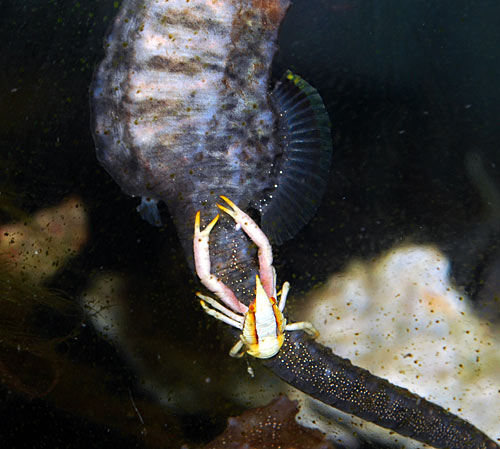
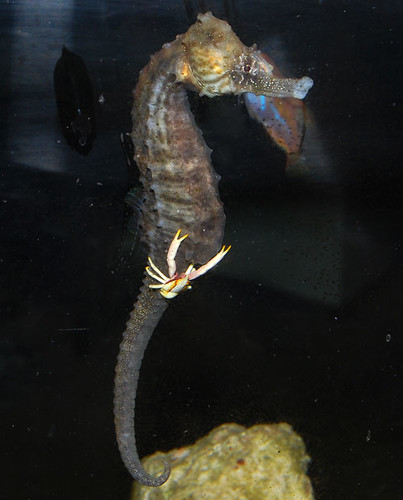
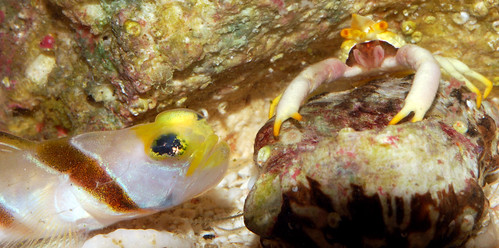
I had a wonderful weekend as a bridesmaid at an outdoor Halloween wedding, or "Hallowedding." Unfortunately, I got the flu and didn't even look at my aquariums for a few days. (My husband was kind enough to feed the seahorses and new Flashing Tilefish for me.) I got up this morning for work and decided to pop a cube of mysis in for the seahorses quickly. I glanced in right before leaving and saw something strange on Hoover, one of my female seahorses. I looked closer, and saw my newest Crinoid Squat Lobster hosting on her!
At first, I was shocked. This is not normal behavior. I wanted to knock the thing off or her as quickly as possible, but I had to grab a couple quick snapshots of the situation first. I think the squat lobster was smart for doing this, because as Hoover swam up to the top of the water to eat some mysis, the squat lobster grabbed some mysis, too. I don't know how it thought a seahorse was similar enough to a Crinoid to host on it, but it worked. Maybe someday squat lobsters will figure out that seahorses are better hosts than Crinoids, because they move toward the food instead of waiting for the food to come to them. It was sort of funny, because the squat lobster seemed a bit triumphant in his experiment, but also a little confused as to why his host was moving around so much. He looked like a cowboy trying to hang onto a bull.
Hoover didn't seem irritated by the squat lobster. Normally if something is on her (like another seahorse), she bucks and shakes, trying to dislodge it. Even though she was acting normal with the squat lobster attached to her, it made me really uncomfortable. So I grabbed her and shook it off of her. She went back to eating right away, and the squat lobster sunk to a crevice in a rock, where he has stayed.
Welcome to Felicia's Aquarium Adventures, your number one source for pet Crinoid Squat Lobster information!
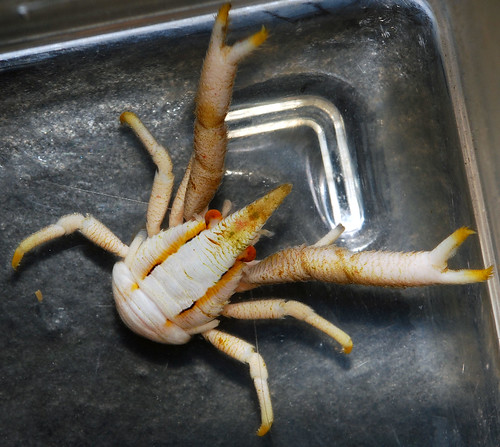
A couple weeks ago, I was happy to find a large white and yellow Allogalathea elegans that I think was a female. Similar Galatheid crabs can be sexed by the width of the carapace; females have a wider carapace than the males for carrying eggs. But another close relative, the porcelain crab, the females are significantly smaller than the male. Either way, I think there is a difference in width between male and female Crinoid squat lobsters.
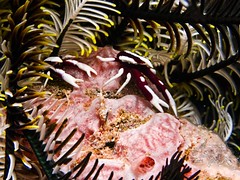
The photo above is a wild gravid female Crinoid squat lobster in its host. Most of the squat lobsters I see are probably juveniles or males, so I don't often see the ones with wider bodies, like the one pictured below.
After seeing my black Allogalathea elegans and my Galathea inflatasharing a Crinoid, I had the idea to try to make a pair of one of my squat lobsters. I've talked to divers who say it's rare to see more than one squat lobster on a Crinoid in the wild. No one is quite sure if they live as pairs or prefer solitude. Sadly, the new squat lobster didn't live through acclimation. My dreams of having a pair of squat lobsters were dashed.
I did find another yellow squat lobster soon after, but I believe it is either a male or a juvenile. I bought him and added him to my aquarium where he started a game of musical Crinoids with the other squat lobsters.
I've never actually seen my squat lobsters battle, but I see the aftermath. There are two Crinoids in my aquarium, both are black. They've been alive, honestly, longer than I expected. One is in pretty good shape still, and it is the preferred Crinoid. The other lost the tips of its arms long ago. Darth Maul, my 2+ year old Galathea inflata, in August was sharing the good Crinoid with Darth Vader, an Allogalathea elegans who has been with us about 6 months. For a few weeks, it seemed like a truce had been struck between the two. Then one day, I woke up to find Darth Maul's molt under the good Crinoid. Darth Vader was there, but Darth Maul was missing. When I finally found him, he was in the small Crinoid and missing an arm. There must have been a feirce battle while Darth Maul was molting and Darth Vader found him in a weakened state.
Squat lobster status quo was reached and maintained until a third squat lobster, the yellow and white one my husband dubbed "Bananarama II" was added to the aquarium. This is when the game of musical Crinoids commenced. The next day, Bananarama was in the small Crinoid, Darth Maul was in the preferred Crinoid, and Darth Vader was alone. The day after that, Darth Vader took the small Crinoid from Bananarama, who I found on the complete other side of the 4 foot aquarium. Here he is next to my special-needs goby and laying claim to this empty snail shell
I still have the two black Crinoids in my aquarium, but the purple one slowly fell apart and died. The black ones are not doing bad, still extending their arms to feed.
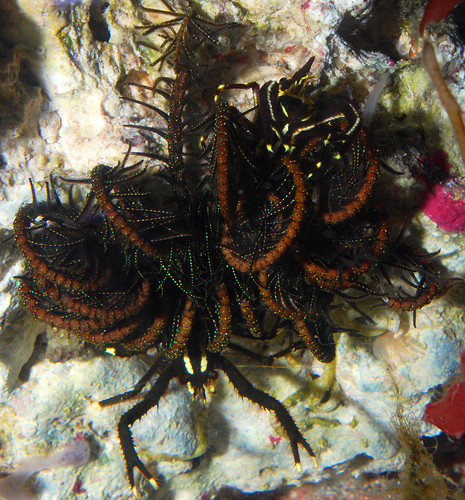
I was surprised last night when I glanced at one of the Crinoids to find that both of my squat lobsters were hosting in it.
Darth Maul, in the lower half of the photo, is a Galathea inflata. He prefers to cling to the rocks underneath a Crinoid. Sometimes he moves to a different Crinoid, and sometimes doesn't stand under one at all. Darth Vader, in the upper portion of the photo, is an Allogalathea elegans. He is always in a Crinoid, usually in the center or on the arms.
Squat lobsters are solitary creatures, so it's unusual to find them sharing a Crinoid. These two have not been fond of one another, either. Darth Maul has chased Darth Vader from his favorite Crinoid before. But it looks like they've made a truce. There is another Crinoid in the aquarium, exactly like this one, but they both prefer this one. They are still sharing this morning, I wonder how long this will last.
I finally finished moving my aquariums around the kitchen. The 55 gallon with the 20 gallon sump is now home to all the reef fish, inverts, non-photosynthetic corals, and seahorses. The 25 gallon nano bullet tank is now a coral-only tank. The 37 gallon, which used to be the seahorse tank, is now a planted guppy and Limia tank. I usually go to bed pretty early, but some night I'll try to stay up past dark and get a shot of all three tanks with the lights off in the kitchen so you don't have to look at my refrigerator.
I had to combine the two saltwater tanks and was nervous at first about how everyone would get along. So far, there haven't been any major problems. There was a squat lobster confrontation, however, on the first day. Darth Maul, the Galathea inflata, evicted Darth Vader, the Allogalathea elegans, from its favorite black Crinoid. In the wild, Darth Vader would have been eaten immediately without the protection of a Crinoid. So it felt that it had to move quickly to the nearest Crinoid, which happened to be my newest Crinoid, a purple one. It was obvious that Darth Vader did not like the purple Crinoid much, because it made its way to the nearest uninhabited black Crinoid soon after. Darth Maul, the Galathea inflata, does not live on the center of the Crinoid like Darth Vader does. Instead, it stands on the rock underneath the Crinoid's outstretched arms.
What I found interesting is that the short, tufted antennae on either side of its rostrum were pointed toward the Crinoid the whole time it was travelling toward it. I wonder if commensal squat lobsters use those to chemically sense, or smell Crinoids. I wish I knew what those little antennae, circled in red on the picture at left, were called.
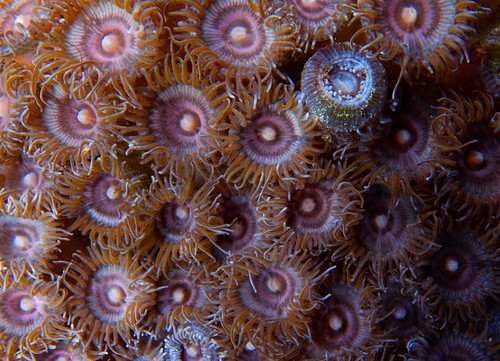
I found this pretty Zoanthus gigantus rock at my local store. Since I was good at the doctor and didn't hit the anesthesiologist this time, my husband let me buy it. For this photo, I tried out my new surface viewer while the coral was in acclimation. I think it turned out pretty well.
The light fixture I won from a raffle is kind of broken. Only some of the bulbs light up now. That's ok, since this is a non-photosynthetic tank now, and the hair algae is dying. Both the actinics light up, which looks pretty nice. Here's my sea cucumber under actinic lighting. It's still doing well and eats phytoplankton every day. It's difficult to tell since they change shape so much, but I think it has grown. It definitely hasn't gotten smaller. You can also see in the photo a small, white tuft coming out around the mouth. Since taking this photo last week, it has grown into a regular sized feeding tentacle. I don't think the animal hasn't lost any tentacles, so I wonder why it's growing new ones.
It's been a while since I've had a squat lobster-Crinoid update. The Crinoid feather star is still doing well; it is extending its arms farther and more often now. So far I haven't noticed any deterioration of the arms, even with the squat lobster living on it.
The squat lobster is also doing very well. If a squat lobster could be happy, I would say this one is quite content. The photo above shows the squat lobster, named "Darth Vader," eating the Mysis shrimp prize it found in one of the arms of its feather star.
This is the second squat lobster-Crinoid update in a week. But I just can't get over how cool symbiosis is. While I was feeding the seahorses last night, some pieces of mysis got caught in the outstretched arms of the Crinoid. The squat lobster, who was hiding at the base of the Crinoid, practically ran on the arms of the Crinoid to get the food. I wasn't fast enough with my camera, but here are some photos of him standing on the Crinoid's arms waiting for more mana from heaven.
I am tired of my point and shoot camera. It's done well for me for five years. Most of the photos on this blog were taken with a Canon A510. But I think it's time I splurged on a better camera. So, yesterday, I bought a Nikon D60. It should come in the mail by next week! I want to thank my mom for helping me; she is always supportive of me and my dreams. Most of my experience is with the Nikon brand, so I already know how to use this camera. I'll be using the lens it comes with, the 18-55mm f/3.5-5.6G AF-S DX VR Nikkor Zoom Lens. It gets good reviews for a cheap lens, but it's not a macro lens. Most of the photos I take are macro photos. The specs say it can be as close as .9 feet to the subject. I've had pretty good results from the Opteka close-up lens kits, so I bought similar ones that can screw on the front of my Nikon lens. The depth of field is really small, but it's cheaper than spending $500 on the true macro lens I really want.
I recently received an email from a Biology student working with Crinoids. He says that the squat lobsters use the Crinoids, which may be toxic, to hid from predators. Squat lobsters also steal food from the Crinoid. My squat lobsters all eat large pieces of Mysis shrimp without the help of a Crinoid. I don't think they require Crinoids for survival, because I've had my Galathea inflata since November 2007, and it has increased in size by about 25%.
I think I may have seen the squat lobster "combing" through the Crinoids feathery arms. Since it is difficult to feed these sea stars in captivity, I wonder if the squat lobster will increase its chance of starvation in my aquarium. Chuck Raabe has a little section on these squat lobsters and says they are "Klepto-parasites that don't directly harm the host but steal its food." I'll have to try to think of a way to keep the squat lobster well fed so it doesn't steal too much from the feather star. Or I could relocate the squat lobster. I don't know anyone who has kept one of these Crinoids in an aquarium for longer than six months, so if I make it past that point, I will be satisfied.
I want to make a point to say that I did not purchase this Crinoid. I do not recommend purchasing animals from your local shop that have a poor survival rate in captivity. That will just encourage your local shop to order and sell more of them. It is for the same reason I do not encourage purchasing an animal from a shop just to "rescue" it from poor conditions there. I would never attempt to keep an impossible creature like this one if it was not accidentally imported (hitchhiked) and then given to me to care for.
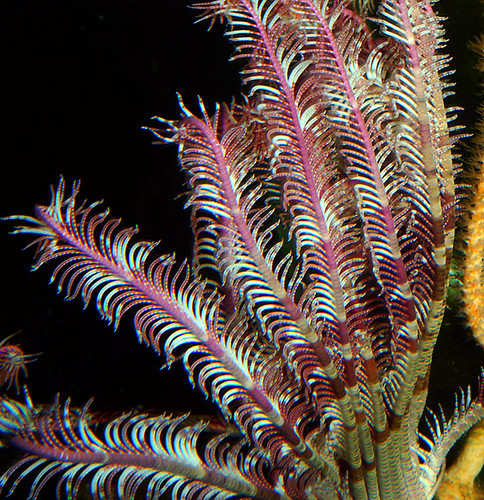
My local place found a Crinoid feather star as a hitchhiker in one of their shipments. Since I have a non-photosynthetic aquarium and dose phytoplankton, they decided my tank would be the best (local) home for it. I also think it will be interesting to see the behavior of my Crinoid squat lobster Allogalathea elegans with this Crinoid feather star. (My Galathea inflata is in the other tank to prevent squat lobster disputes...)
I've had the star for a few days now, and it is very cryptic. It hangs upside down under some of my branch rock in the exact spot where I placed it after acclimation (near the squat lobster). I'm considering getting a small lunar light so I can view it when it is most active at night. I've seen a couple arms come out during feeding time, but that's all I've seen of it. My squat lobster usually hangs out in a Gorgonian, but I haven't seen it since I put the feather star in. Maybe it's under there with the Crinoid.
To prepare for the addition of this sea star, I made sure to cover my pump intakes with fine mesh bags. I wouldn't want it getting the tips of its arms chopped off when it finds a cozy spot too close to the pump's impeller.
The other non-photosynthetic tank inhabitants are doing very well (as far as I know.) My hard tube coco worm Protula bispiralis has grown about two full inches since I got it a couple months ago! My sea cucumber Pentacta anceps still extends and "licks" its feeding arms when I dose phytoplankton. And of course, the seahorses are doing well.
I will let you all know how the Crinoid feather star does. They are notoriously impossible to keep in home aquariums and usually starve to death slowly. If you've had success with this species and kept it alive longer than 6 months, please give me some advice. Otherwise, just wish me luck.
My seahorse aquarium with 3 juvenile seahorses, 2 adult seahorses, bluestriped pipefish, Trimma goby, red scooter dragonet, and squat lobster. The Brotulids are hiding, sorry.
Since Nano aquariums have become very popular over the past few years, I'll share with you some of my favorite Nano-crustaceans.
Many beginner aquarists tend to focus mainly on fish when adding stock to a new aquarium. I think this is because most people start with freshwater aquariums, and there are not a lot of freshwater aquarium invertebrates. Many Nano aquariums are too small for fish. Even the largest Nano aquarium (25 gallons is still considered a "nano" tank) should only contain a few very small fish. Invertebrates produce less waste than fish, so more of them can fit into a small aquarium. The number and variety of saltwater invertebrates available to hobbyists is staggering. The colors, shapes, and behaviors of these animals rival those of fish. So why not make a marine Nano aquarium invertebrate showcase?
Many of the invertebrates I'm going to write about are cryptic and would rarely be seen in a regular sized aquarium. These are ideal for a small aquarium with some live rock and corals.
Galatheids, or squat lobsters and porcelain crabs, are some of my favorite nano-inverts. They are among the most peaceful invertebrates and are completely reef safe. They are very small, most reaching only up to 1-1/2" or 2" in size. Unless you find a mated pair, two of the same species shouldn't be kept in the same aquarium; they will fight. Common Squat lobsters can sometimes be found as hitchhikers on live rock or corals and make fine pets. These are usually dull colored, though. Crinoid squat lobsters such as the ones pictured above are becoming more common and can be purchased from Liveaquaria.com's Diver's Den. In the wild these crustaceans are commensal on Crinoid feather stars. They use the sea stars for camouflage and steal their food. Crinoid feather stars are next to impossible to keep in aquariums. Luckily, these Crinoid squat lobsters do not require them for survival. They readily accept frozen foods and adapt well to aquarium life. The Galathea inflata in the bottom photo above has been living in my aquarium since November 2007.
A more rare and unusual crab for the nano aquarium is the Zebra crab, Zebrida adamsii. This crab is very peaceful with its tankmates, and it's almost totally reef safe. It does not harm corals, fish, or other crustaceans. However, this crab is an urchin parasite. In the wild they host on fire urchins Asthenosoma varium, consuming their spines. They can move from one urchin to another and do little harm to the urchins. Unfortunately, they only eat urchin spines and do not accept frozen or prepared foods in captivity. Since fire urchins are highly venomous and rare in our hobby, other urchins can be substituted. Pincushion urchins and longspine urchins are favorites of this crab in captivity. It may be necessary to provide urchins continually every few months, as the health of the urchin will decline over time while the crab hosts on it. To prolong the life of the urchins, provide at least two or three per crab. These crabs are highly territorial, so only one per tank is recommended.
If you plan to keep a fish in your Nano aquarium, I would recommend a shrimp goby. Shrimp gobies form fascinating relationships with pistol shrimps from the genus Alpheus. The pistol shrimp digs a burrow in which both animals live, while the goby provides food and warns the poor-sighted shrimp of danger. Any time the shrimp is outside the burrow, it keeps an antennae on the body of the goby. The goby hovers above, acting as a lookout. If the goby is alarmed, it will warn the shrimp with a flick of its tail and dart into the burrow after the shrimp.
The lovely shrimp in the above photo is an Alpheus ochrostriatus, which pairs with gobies of the genus Amblyeleotris and Ctenogobiops.
Some other interesting shrimps for the Nano aquarium include species from the Periclimenes and Urocaridella genus. These shrimps are almost completely translucent with most species having colorful markings. Periclimenes shrimps are usually commensal on anemones or corals, depending on the species, but do not require them for survival in captivity. Urocaridella shrimps are cleaner shrimps. These peaceful, miniscule shrimps only grow up to 1-1/2" on average and readily accept prepared foods in the aquarium. Periclimenes venustus is my personal favorite in this group. I like to call them the "Hand Jive Shrimp" because of the way they wave their claws. Photo from Teguh Tirtaputra's photostream.
One of the oddest looking shrimps for the Nano aquarium is the Ghost Pipe Shrimp, Leander plumosus. Not much is known about this cryptic species, except that their body shape may be used to mimic pipefish, and that like some pipefish, they may be cleaner animals.
I can not write this post without mentioning the shrimps from the family Gnathophyllidae. This family includes Harlequin shrimps and Bumblebee shrimps. Shrimp from this family typically feed on Echinoderms (sea stars and urchins.)
Harlequin shrimp, Hymenocera elegans and H. picta, are indisputably the most beautiful shrimp that can be kept in an aquarium. They have cream colored bodies with purple, blue, and pink markings and paddle shaped claws. Their diet consists exclusively of starfish, most notably from the genus Linkia. They can be expensive, with pairs being sold for around $80.00. But it's worth it. Harlequin shrimp photo by Sergey Parinov.
A less expensive and easier to keep alternative to the Harlequin shrimp is the Bumblebee shrimp, Gnathophyllum americanum. This is the smallest animal I will write about today. Most only reach about 3/4" in size. They will accept frozen meaty foods like cyclops and mysis. Bumblebee shrimp photo from Underwater Australia.
The last shrimp I'll write about today is the Bongo Shrimp, Phyllognathia ceratophthalmus. They are very rare in the aquarium trade, and not much is know about them and their habits. They are closely related to Harelquin shrimps. They command a pretty high price tag, about $100 for a pair. These would be the ultimate Nano-crustacean for the aquarist who loves rare and unusual beauties. Liveaquaria has an amazing video of one of these shrimp eating a brittle star.
Also check out this Youtube video of a Bongo Shrimp in the wild by N. Akimoto: