Showing posts sorted by date for query pom pom. Sort by relevance Show all posts

Jun 28, 2009

Pom Pom Crabs and Basket Stars

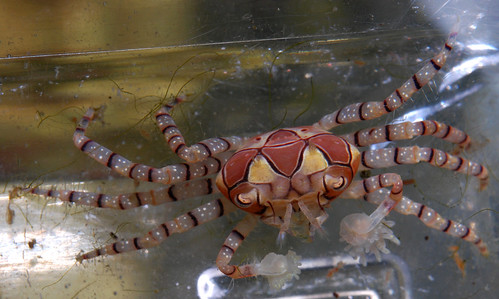
The pom pom crabs I ordered have arrived! They are in perfect condition, and the acclimation couldn't have gone any smoother. I placed them next to my older pom pom crab in the aquarium, and they seemed to get along fine. As you can see from the pictures, one of the new pom pom crabs is definitely a female. Note the bright orange eggs on her abdomen. Please forgive the hair algae stuck all over the crabs, that came from my aquarium...

pom pom crab

pom pom crab with eggs

I'm doing a little experiment to see if it's true that pom pom crabs share their anemones with one another, then frag them to make more. I think it's more likely that they steal anemones from each other. When a pom pom crab molts, it puts down its anemones for a short time until it can shed its old exoskeleton and pick them back up again. Perhaps that is when they are most vulnerable to anemone theft! Unless I see it happening, I may never know. But hopefully my older pom pom crab acquires some new anemones somehow, because she lost hers a few months ago and has been carrying around sponges instead. It's kind of sad and pathetic.
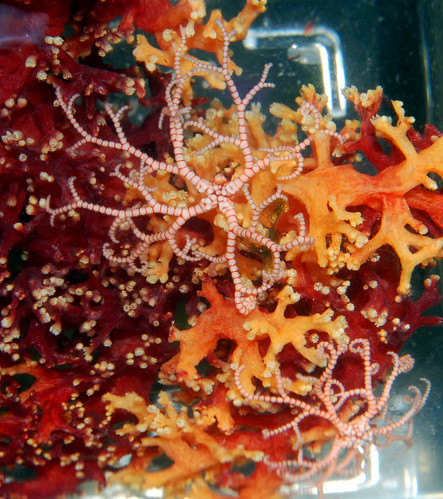
Basket Starfish

Word has gotten around that I like Crinoids and other non-photosynthetic animals, so I was given some basket stars last week. Thanks, Joe! You're awesome!
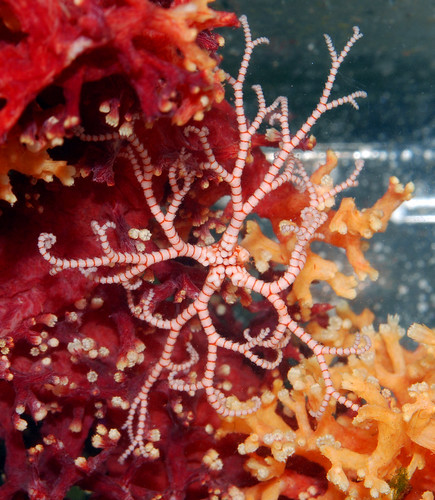
Basket Starfish

I have no idea what species these basket stars are. If you click on the photo to enlarge it, you can see that they are pinkish with red-orange stripes all over them. If I had to name them, I'd call them "candy-striped basket stars." They are only about the size of a nickel when they spread out. These are the smallest basket stars I've ever seen, hopefully they'll be easier to feed as a result. They came on this gorgeous non-photosynthetic orange and red soft coral, which I also couldn't ID. It reminds me of corals related to Dendronepthea sp. and Stereonephthya sp. Anyone know what this is? It wasn't attached to a rock, so I rubber-banded it to a heavy coral mariculture plug. I'm going to pin it tomorrow with a long stainless steel frag pin. The stars haven't strayed from the coral yet.

The other basket starfish I got this week is a Caribbean basket starfish, Astrophyton muricatum, similar to the one pictured. I had that one come in as a hitchhiker on a Gorgonian order a couple years ago, and it didn't last long. That is how I learned that basket starfish can crawl inside return pumps and get destroyed by the impeller. Since then, all my pumps have been covered with ugly mesh bags. The one I got this week is about the size of a large man's hand when it is stretched out. This species grows to three feet in diameter in the wild.

I hope to do better with this basket star than with my last one. Like most other non-photosynthetic marine creatures, the majority of the basket star's diet will have to come from my aquarium's refugium and sand bed. In the wild Caribbean basket stars prefer to eat pelagic copepods and other small zooplankton, so Cyclop-eeze, Cyclops, and rotifers are an ideal supplemental diet for a small to medium-sized basket star.
Here's an older article about basket stars on reefs.org http://www.reefs.org/library/article/r_toonen17.html

Jun 18, 2009

Aquarium Update

All my aquatic pets are doing well. I'm dealing with some condensation on the glass now that summer is here and I chill my aquarium to 72 degrees. The algae is coming back with a vengeance and threatening my corals. I'm considering starting a nano tank just for my corals. I have a 20 gallon bullet tank, but it currently houses my freshwater livebearers. I doubt my husband will alow me to get ANOTHER aquarium, so I'll have to either get rid of the algae or get rid of my livebearers.

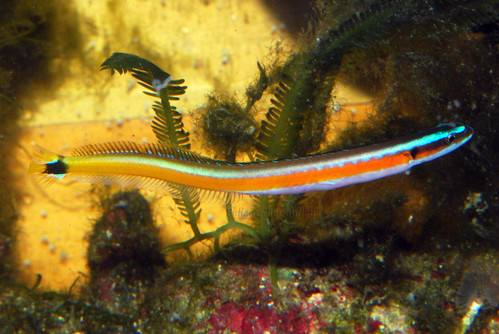
Curious Wormfish

The Curious Wormfish is doing great and eating a lot. He spends most of his time buried in the sand, but when I feed the aquarium he emerges to feed. It's strange to see a tiny blue head poking up out of the sand, waiting for the perfect, calm moment to burst out and begin hunting Mysis. He's now eating the large PE Mysis, about 2 or 3 pieces a day. After dinner, he may stay out for a couple hours, then buries himself in the sand again.

I just ordered some pom pom crabs, they should be arrving soon. My pom pom crab, who is a couple years old now, lost her anemones a few months ago. Hopefully her new friends will share their anemones with her.

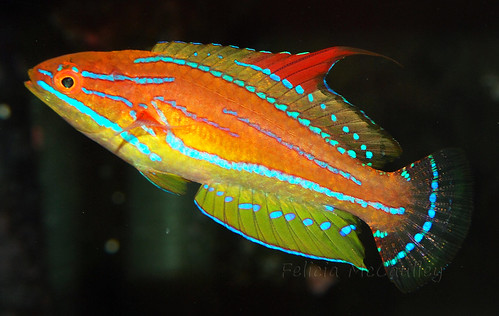
Yellow Fin Flasher Wrasse

My yellow-fin flasher wrasse accidentally went over the overflow box and now lives in my seahorse tank. I'm not very good at catching fish, so he has stayed there. It's been a few weeks now, and my Rubriventralis fairy wrasse has turned into a male within that short time. "His" ventral fins are a gorgeous black-red color, and the blue on his tail and body glows. I promise to post better pictures soon.

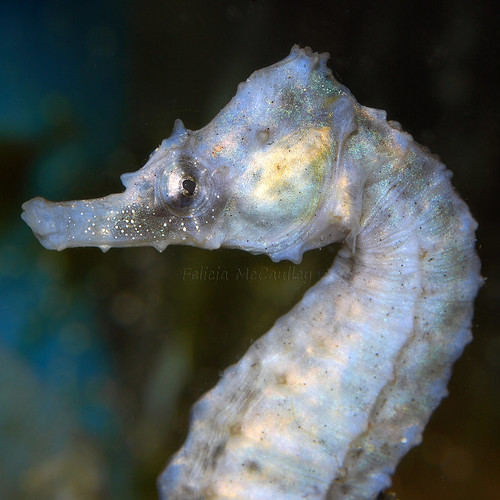
White Seahorse

The Erectus seahorses are also doing great. They are growing so big! It's hard to believe that just five months ago, they were tiny juveniles, only a few inches tall. I love this picture of Hoover, who is usually black. She turns white when I feed her or when she is being courted by Juniper or Debelius. Click on the photo for more detail.

The one-eyed goby my friend Paul got me for my birthday in April has finally started to gain some weight. Well, technically, he has two eyes, but one is severely deformed. When I first got him, I was concerned that he wasn't eating enough because he can't see anything on his right side. I try to target feed him, but if the food falls to his right side, he can't see it at all. He is less shy now and is confident enough to compensate for his eyesight by swimming in circles to look around.

Honestly, I'm surprised that my Crinoid feather star is still alive. All of its arms are intact, and it seems to be thriving. I put a fish net in my seahorse tank in an attempt to get the flasher wrasse used to it so I could catch him better. The Crinoid decided to make that fish net its home, so now I can't remove the net. The squat lobster is less shy now and is always visible on the center of the Crinoid. I'm noticing that the squat lobster doesn't steal small food particles from the Crinoid, only larger pieces (like Mysis) that fall and get stuck in its arms.

Lastly, one of my female Brotulids has slowly been getting fatter and fatter, till recently, her stomach turned dark and swollen. She definitely looked like the pregnant Brotulids I've seen before. The strange thing is that I don't have a male of the same species in the tank with her. She hasn't been around a male in almost a year. I'm not sure if they can store sperm the way that freshwater livebearers can, or if she possibly mated with the yellow Brotulid who is from a different genus and has radically different genitalia. Last week, I noticed that the front of her belly was flat, and a long black shape was still visible near her vent. The next day, it too was gone, and she now looks exactly like her sister. These fish are so ridiculously cryptic, I can only view the adults with a small flashlight I keep near the tank. Most people who buy Brotulids for their aquariums never see them again, or see them years later when they tear down their tanks. I can't help but wonder if I now have a couple baby Brotulids...

Mar 3, 2009

Pom Pom Crabs - Perfect Nano Crabs

Since Nano aquariums have become popular, hobbyists are always looking for tiny, peaceful animals to live in them. I think crustaceans make excellent Nano tank inhabitants because they produce less waste than fish and need less room.

One deserving Nano crustacean is too often overlooked because it is cryptic and nocturnal - the pom pom crab, Lybia tesselata. See one of my pom pom crabs pictured below.

pom pom crab

Probably the most fascinating aspect of these crabs is their symbiotic relationship with tiny anemones of the genus Triactis or Bunodeopsis. The crab holds the anemones (which contain stinging nematocysts) in each claw and uses them for defense. These crabs literally pack a powerful punch. I once saw one of my gobies try to evict my pom pom crab from its hole in the rock when the crab "punched" the goby in the face with its anemone. There was no permanent harm, but I'm sure the goby will think twice before trying that again. Pom pom crabs also use their anemones' sticky tentacles to help them "mop up" food. This feeds the crab, and in turn, feeds the anemones. The crabs mostly eat meaty foods and are considered aquarium scavengers. They should be target fed in the aquarium.

Pom pom crabs are naturally nocturnal and very cryptic. When housed in a large or medium sized aquarium, they will rarely be seen. The best time to view them is at night, with the lunar lights on. The crabs are very hardy and can be housed in a small aquarium with no problem. However, the anemones can not tolerate unstable water parameters and often die shortly after being added to an aquarium. Nano aquariums are known for having unstable salinity and water parameters. This is why it is best to add your pom pom crab only to a well established, stable Nano aquarium. An auto top off system can help with this.

pom pom crab with eggs

If your pom pom crab loses one of its anemones, it can split the other in half and make two anemones. If your pom pom crab loses both anemones, it will still survive, but may start chopping up and carrying around your Zoanthus or coral polyps. If you have more than one pom pom crab, these social creatures will actually share anemones. If a crab loses both anemones, its generous "friends" may cut one of theirs to give.

Some people consider these crabs not to be reef safe because of the stinging power of its anemones. I believe that since the anemones are so tiny, they pose no threat whatsoever to healthy corals or fish. I even keep mine with seahorses and tiny gobies.

Update: https://reefs.com/2017/02/26/pom-pom-crabs-fun-nano-pets/