Showing posts sorted by relevance for query flasher wrasse. Sort by date Show all posts

Sep 13, 2018


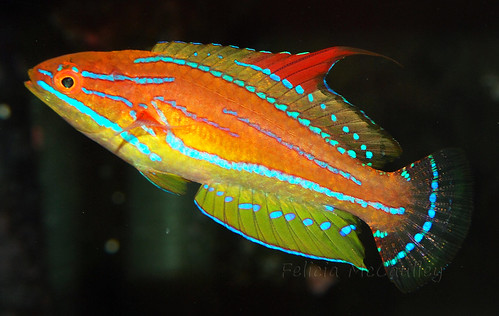
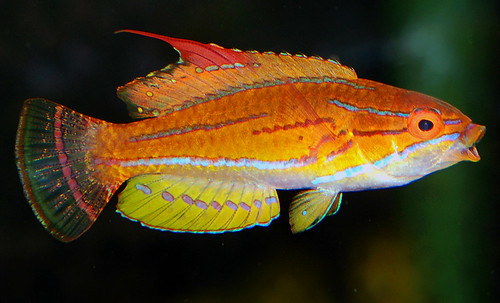
The Flashiest of Wrasses: The McCosker’s Wrasse!

My parents set up a 30 gallon reef tank about 6 months ago, and they were looking for one perfect fish for their tank. I suggested clownfish, but they think those are are boring. I showed them dozens of easy, peaceful, small reef-safe fish, and they fell in love with the McCosker’s wrasse.

Paracheilinus Wrasse or McCosker’s Flasher Wrasse do best in 55 gallon or larger aquariums, but we planned on them being the only fish in the 30 gallon tank. My parents bought a male/female pair at our local fish store on an impulse, worried someone else would buy them.

I stopped by their house to help acclimate the fish, and realized they had not yet installed the net around the aquarium’s canopy to prevent the fish from jumping. I knew from previous experiences with this fish, it is imperative to have a fully enclosed top. These fish can jump high, and they can jump accurately. If you have even a tiny, unnoticeable gap between your net and a U-tube or heater’s wire, they’ll find a way to get through it.

Luckily, they had some fine mesh netting in the basement, so we were able to cut it and staple it to the canopy temporarily while the fish drip acclimated.

They were worried that the fish looked dead in the acclimation bucket, but I reassured them that it is normal for this type of wrasse to lie down and appear mottled for camouflage. It’s also common for them to do this in small containers, but they recover quickly when given room to swim. Don’t be alarmed if you see your fish lying on the bottom of the tank at night covered in slime, since these fish form mucous cocoons at night to sleep in.

I warned them that the fish might hide for a while, but our LFS did a great job of conditioning them. They were out the next morning, eating frozen mysis shrimp and brine shrimp. We plan to also add some tasty, nutritious oyster eggs and copepods to their diet to help provide a more complete nutrition, besides who wants to eat the same thing everyday?

I recommend quarantining all new fish. This species tends to suffer from Monogenean Flukes, which are microscopic or tiny clear flat worms that crawl on the skin and eyes of the fish, eating the mucous and causing damage. A short freshwater dip (make sure to match the pH to your tank) can remove most of the flukes, and treatment with Praziquantel in the quarantine tank can remove any leftover flukes.

It’s also a great idea to treat these fish for Cryptocaryon, aka ICH, before they are added to your display tank with other fish. They don’t tolerate Copper or Chloroquine Diphosphate well, so use the tank transfer method instead. If you notice your fish losing weight despite eating well, treat for internal parasites by soaking their food in Metronidazole and Prazi-Pro.

These fish are always beautiful, but when they display their “nuptial colors,” they are downright electric. The Males will display for females, other males, or mirrors. The male will flare all of his fins as large as possible while doing an erratic back and forth dance. The blue lines on his body appear to glow from the inside. The more females you have per one male, the more he will flash and display. It’s best to have just one male per tank, but some experienced keepers have multiple males in large aquariums.

articles and photos by Felicia McCaulley

Jun 18, 2009

Aquarium Update

All my aquatic pets are doing well. I'm dealing with some condensation on the glass now that summer is here and I chill my aquarium to 72 degrees. The algae is coming back with a vengeance and threatening my corals. I'm considering starting a nano tank just for my corals. I have a 20 gallon bullet tank, but it currently houses my freshwater livebearers. I doubt my husband will alow me to get ANOTHER aquarium, so I'll have to either get rid of the algae or get rid of my livebearers.

Curious Wormfish

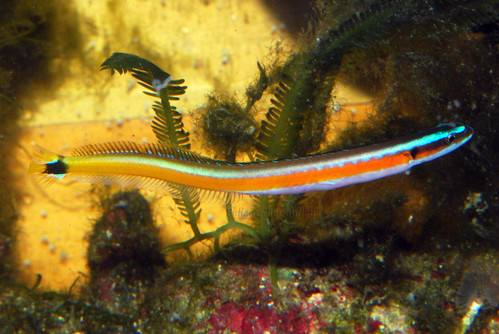
The Curious Wormfish is doing great and eating a lot. He spends most of his time buried in the sand, but when I feed the aquarium he emerges to feed. It's strange to see a tiny blue head poking up out of the sand, waiting for the perfect, calm moment to burst out and begin hunting Mysis. He's now eating the large PE Mysis, about 2 or 3 pieces a day. After dinner, he may stay out for a couple hours, then buries himself in the sand again.

I just ordered some pom pom crabs, they should be arrving soon. My pom pom crab, who is a couple years old now, lost her anemones a few months ago. Hopefully her new friends will share their anemones with her.

Yellow Fin Flasher Wrasse

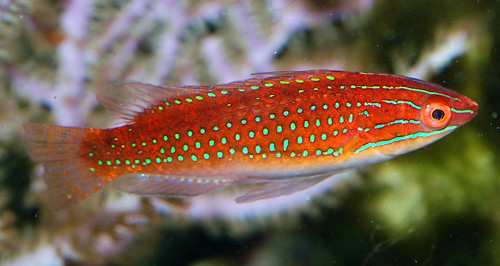
My yellow-fin flasher wrasse accidentally went over the overflow box and now lives in my seahorse tank. I'm not very good at catching fish, so he has stayed there. It's been a few weeks now, and my Rubriventralis fairy wrasse has turned into a male within that short time. "His" ventral fins are a gorgeous black-red color, and the blue on his tail and body glows. I promise to post better pictures soon.

White Seahorse

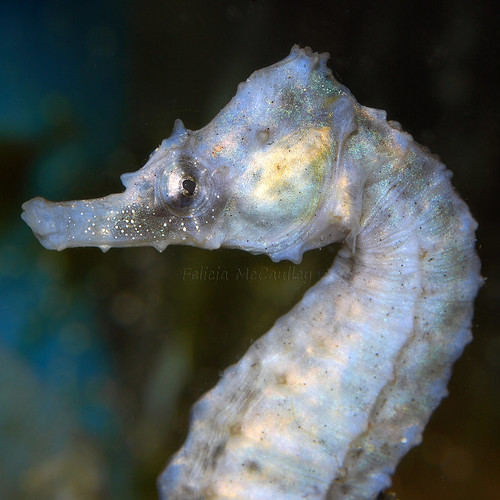
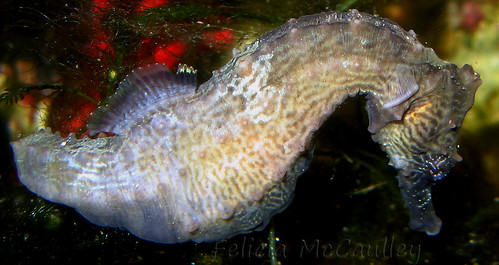
The Erectus seahorses are also doing great. They are growing so big! It's hard to believe that just five months ago, they were tiny juveniles, only a few inches tall. I love this picture of Hoover, who is usually black. She turns white when I feed her or when she is being courted by Juniper or Debelius. Click on the photo for more detail.

The one-eyed goby my friend Paul got me for my birthday in April has finally started to gain some weight. Well, technically, he has two eyes, but one is severely deformed. When I first got him, I was concerned that he wasn't eating enough because he can't see anything on his right side. I try to target feed him, but if the food falls to his right side, he can't see it at all. He is less shy now and is confident enough to compensate for his eyesight by swimming in circles to look around.

Honestly, I'm surprised that my Crinoid feather star is still alive. All of its arms are intact, and it seems to be thriving. I put a fish net in my seahorse tank in an attempt to get the flasher wrasse used to it so I could catch him better. The Crinoid decided to make that fish net its home, so now I can't remove the net. The squat lobster is less shy now and is always visible on the center of the Crinoid. I'm noticing that the squat lobster doesn't steal small food particles from the Crinoid, only larger pieces (like Mysis) that fall and get stuck in its arms.

Lastly, one of my female Brotulids has slowly been getting fatter and fatter, till recently, her stomach turned dark and swollen. She definitely looked like the pregnant Brotulids I've seen before. The strange thing is that I don't have a male of the same species in the tank with her. She hasn't been around a male in almost a year. I'm not sure if they can store sperm the way that freshwater livebearers can, or if she possibly mated with the yellow Brotulid who is from a different genus and has radically different genitalia. Last week, I noticed that the front of her belly was flat, and a long black shape was still visible near her vent. The next day, it too was gone, and she now looks exactly like her sister. These fish are so ridiculously cryptic, I can only view the adults with a small flashlight I keep near the tank. Most people who buy Brotulids for their aquariums never see them again, or see them years later when they tear down their tanks. I can't help but wonder if I now have a couple baby Brotulids...

Feb 18, 2009

My new Cirrhilabrus fairy wrasse

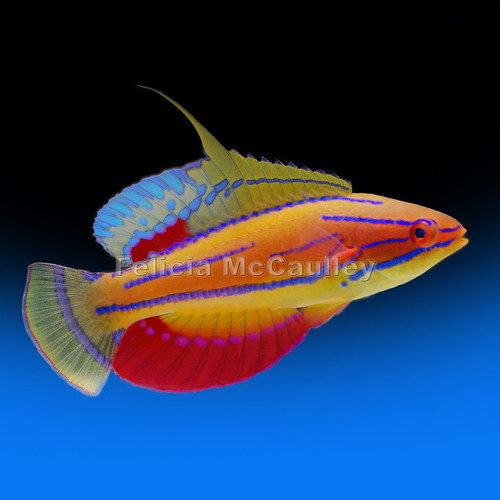
I bought my very first fairy wrasse on Friday. She is a long fin fairy wrasse, Cirrhilabrus rubriventralis which is often confused with Cirrhilabrus joanallenae. The difference is the color of the pelvic fins. The C. rubriventralis have red pelvic fins ("rubri" means red and "ventralis" means fin on ventral side of fish, such as pelvic fin), and the C. joanallenae have black pelvic fins.

I've been thinking about getting some fairy and flasher wrasses for a long time, but couldn't get past the price. $80 for a super male flasher wrasse is a little steep for me. But if you can find females, they sell for around $30 a fish, which isn't bad at all. Plus, it's best to keep females together at first, and then the most dominant will turn into a male. All fairy and flasher wrasses are protogynous hermaphrodites. They start life as females, then the more dominant one in a group becomes male.

Longfin fairy wrasses are also known as the "fighting fairy wrasse" for a good reason. It's best to keep only one per tank, unless they are sold to you as a mated pair and are getting along. A male and female that are not already acquainted with one another will probably fight.

This isn't the best photo of this species, here is "Venus," my long finned fairy wrasse.


I'm shopping for more wrasses, but I'm going to have to stick to smaller species because I only have a 55 gallon aquarium. If you plan to get some fairy or flasher wrasses, be careful, they're jumpers! I had to cover the spaces in my hood with pond netting to keep them from jumping.

March Update: "Venus" is doing really well. She swims and flares constantly. She's fat and eats frozen mysis very well. I have also seen her successfully hunt down and catch amphipods in my aquarium just about every day. She is the most accomplished amphipod hunter in my aquarium!

Better Pics Here

Mar 29, 2009

Longfin Fairy Wrasse and Yellowfin Flasher Wrasse

I promised to update with better photos of my longfin fairy wrasse in previous blog entry. I also wanted to show off my male yellowfin flasher wrasse Paracheilinus flavianalis named Mercury. I've had him for a few weeks now, and he is doing great. They eat frozen mysis and cyclops, but also eat live amphipods they catch in the aquarium. The two wrasses get along famously and follow one another around, pecking at the live rock. Mercury regularly flashes and flares for her, and I think she looks impressed. They must not care that they belong to different genera!Paracheilinus flavianalis

Cirrhilabrus rubriventralis

Jan 25, 2010

Tank Crash

I've been putting off writing this blog for a few weeks. I experienced my worst aquarium nightmare over Christmas break. We were traveling a lot to visit relatives, and I wasn't giving my aquariums as much attention as I should have. We're not sure what caused the crash, but one day when I came home, I knew immediately something was terribly wrong. Three out of five of my seahorses were laying dead on the floor of the tank, and the fish that were left were breathing hard, discolored, and obviously stressed. I was quick to blame it on my sea cucumber, Pentacta anceps, but I'm not certain. I estimate that whatever disaster struck, happened right before I came home that day. The fish that died looked as though they had just died, and the ammonia was still at zero ppm.

We quickly did a 50% water change and put a pound of carbon in the filtration. Within a half hour, the fish that survived started to perk up. All in all, the crash could've been much worse. I lost most of my small gobies, 3 of my seahorses (Kuiter, Ellis, and Debelius), my Yellow-fin Flasher Wrasse, and my squat lobsters. All of the other inverts were fine, in fact, my Sun coral was open while all this was going on. My two seahorses Juniper and Hoover, Flashing Tilefish, and all 3 of my shrimp gobies survived (with their shrimp friends), Curious wormfish, 3 Brotulids, and Yellow Eye Anthias survived. Amazingly, one tiny red Eviota goby also survived. The Lionfish and Coral Croucher are in another tank.

I was most devastated by the loss of my seahorses. Seahorses have so much personality, they are truly pets and can't be "replaced" when they are lost. I miss Ellis, Debelius, and especially little Kuiter hitching on my fingers when I put my hand in the tank. I'll be getting a new, larger 120 gallon aquarium soon, so I'll wait to get any more seahorses until after that tank is set up and doing well.

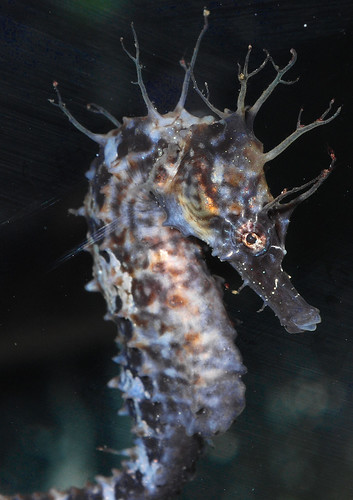
Hippocampus erectus
Kuiter

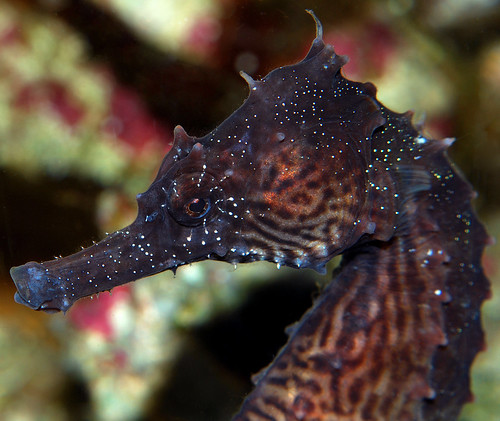
Portrait of Ellis
Ellis

seahorse erectus male
Debelius