Showing posts sorted by relevance for query squat lobster. Sort by date Show all posts

Oct 19, 2009

Squat Lobster Battles

Welcome to Felicia's Aquarium Adventures, your number one source for pet Crinoid Squat Lobster information!

A couple weeks ago, I was happy to find a large white and yellow Allogalathea elegans that I think was a female. Similar Galatheid crabs can be sexed by the width of the carapace; females have a wider carapace than the males for carrying eggs. But another close relative, the porcelain crab, the females are significantly smaller than the male. Either way, I think there is a difference in width between male and female Crinoid squat lobsters.

The photo above is a wild gravid female Crinoid squat lobster in its host. Most of the squat lobsters I see are probably juveniles or males, so I don't often see the ones with wider bodies, like the one pictured below.
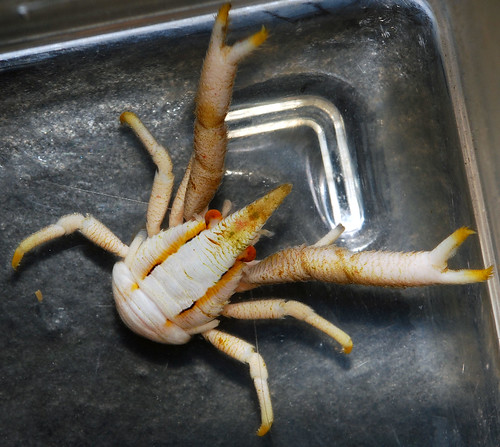
Yellow Allogalathea elegans


squatting lobster
Originally uploaded by Salt Water People
After seeing my black Allogalathea elegans and my Galathea inflata sharing a Crinoid, I had the idea to try to make a pair of one of my squat lobsters. I've talked to divers who say it's rare to see more than one squat lobster on a Crinoid in the wild. No one is quite sure if they live as pairs or prefer solitude. Sadly, the new squat lobster didn't live through acclimation. My dreams of having a pair of squat lobsters were dashed.
I did find another yellow squat lobster soon after, but I believe it is either a male or a juvenile. I bought him and added him to my aquarium where he started a game of musical Crinoids with the other squat lobsters.

I've never actually seen my squat lobsters battle, but I see the aftermath. There are two Crinoids in my aquarium, both are black. They've been alive, honestly, longer than I expected. One is in pretty good shape still, and it is the preferred Crinoid. The other lost the tips of its arms long ago. Darth Maul, my 2+ year old Galathea inflata, in August was sharing the good Crinoid with Darth Vader, an Allogalathea elegans who has been with us about 6 months. For a few weeks, it seemed like a truce had been struck between the two. Then one day, I woke up to find Darth Maul's molt under the good Crinoid. Darth Vader was there, but Darth Maul was missing. When I finally found him, he was in the small Crinoid and missing an arm. There must have been a feirce battle while Darth Maul was molting and Darth Vader found him in a weakened state.

Squat lobster status quo was reached and maintained until a third squat lobster, the yellow and white one my husband dubbed "Bananarama II" was added to the aquarium. This is when the game of musical Crinoids commenced. The next day, Bananarama was in the small Crinoid, Darth Maul was in the preferred Crinoid, and Darth Vader was alone. The day after that, Darth Vader took the small Crinoid from Bananarama, who I found on the complete other side of the 4 foot aquarium. Here he is next to my special-needs goby and laying claim to this empty snail shell
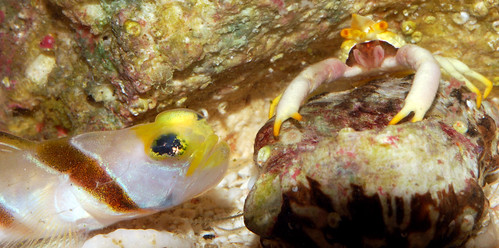
squat lobster and goby


Chucks' addiction has a beautiful gallery of hitchhiking Galatheid squat lobsters.

Nov 5, 2009

Squat Lobster Hosting on Seahorse

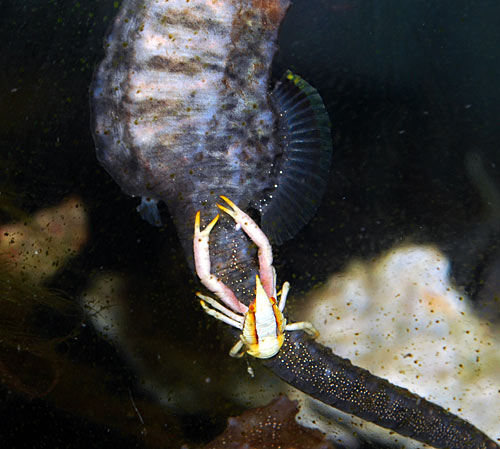
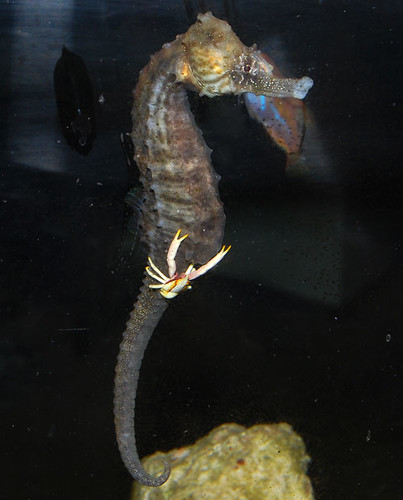
I had a wonderful weekend as a bridesmaid at an outdoor Halloween wedding, or "Hallowedding." Unfortunately, I got the flu and didn't even look at my aquariums for a few days. (My husband was kind enough to feed the seahorses and new Flashing Tilefish for me.) I got up this morning for work and decided to pop a cube of mysis in for the seahorses quickly. I glanced in right before leaving and saw something strange on Hoover, one of my female seahorses. I looked closer, and saw my newest Crinoid Squat Lobster hosting on her!

Squat lobster hosting on Seahorse

At first, I was shocked. This is not normal behavior. I wanted to knock the thing off or her as quickly as possible, but I had to grab a couple quick snapshots of the situation first. I think the squat lobster was smart for doing this, because as Hoover swam up to the top of the water to eat some mysis, the squat lobster grabbed some mysis, too. I don't know how it thought a seahorse was similar enough to a Crinoid to host on it, but it worked. Maybe someday squat lobsters will figure out that seahorses are better hosts than Crinoids, because they move toward the food instead of waiting for the food to come to them. It was sort of funny, because the squat lobster seemed a bit triumphant in his experiment, but also a little confused as to why his host was moving around so much. He looked like a cowboy trying to hang onto a bull.

Hoover didn't seem irritated by the squat lobster. Normally if something is on her (like another seahorse), she bucks and shakes, trying to dislodge it. Even though she was acting normal with the squat lobster attached to her, it made me really uncomfortable. So I grabbed her and shook it off of her. She went back to eating right away, and the squat lobster sunk to a crevice in a rock, where he has stayed.

Squat lobster hosting on Seahorse

Apr 28, 2009

Squat Lobster Sighted on Crinoid

We had a squat lobster sighting today on the Crinoid feather star during feeding time. Sorry for the poor quality photos.

"Crinoids eat a range of microscopic particles, ranging from diatoms, foraminifera, unicellular algae, small crustaceans, larvae and detritus." from http://palaeo.gly.bris.ac.uk/Palaeofiles/Fossilgroups/Crinoidea/page2.html

I recently received an email from a Biology student working with Crinoids. He says that the squat lobsters use the Crinoids, which may be toxic, to hid from predators. Squat lobsters also steal food from the Crinoid. My squat lobsters all eat large pieces of Mysis shrimp without the help of a Crinoid. I don't think they require Crinoids for survival, because I've had my Galathea inflata since November 2007, and it has increased in size by about 25%.

I think I may have seen the squat lobster "combing" through the Crinoids feathery arms. Since it is difficult to feed these sea stars in captivity, I wonder if the squat lobster will increase its chance of starvation in my aquarium. Chuck Raabe has a little section on these squat lobsters and says they are "Klepto-parasites that don't directly harm the host but steal its food." I'll have to try to think of a way to keep the squat lobster well fed so it doesn't steal too much from the feather star. Or I could relocate the squat lobster. I don't know anyone who has kept one of these Crinoids in an aquarium for longer than six months, so if I make it past that point, I will be satisfied.

I want to make a point to say that I did not purchase this Crinoid. I do not recommend purchasing animals from your local shop that have a poor survival rate in captivity. That will just encourage your local shop to order and sell more of them. It is for the same reason I do not encourage purchasing an animal from a shop just to "rescue" it from poor conditions there. I would never attempt to keep an impossible creature like this one if it was not accidentally imported (hitchhiked) and then given to me to care for.

Also check out these lovely Crinoid commensals photos.

Check out this little cutie, he looks just like my squat lobster!
Crinoid Crab in Sulawesi - Watch more Videos at Vodpod.

Jan 15, 2018

Squat Lobsters and Porcelain Crabs - Fun Nano Crustaceans

Porcelain Crabs and Squat Lobsters are neither true crabs nor true lobsters; they are actually Galatheoids, and are more closely related to hermit crabs. Most of the tiny squat lobsters and porcelain crabs you’d find as hitchhikers or for sale at your LFS are reef safe and peaceful. They are best kept singly or in pairs in nano tanks, as they may fight with their own or similar species, but given enough territory, multiples can be housed together.

Crinoid squat lobsters, Allogalathea elegans and Galathea inflata, make their homes on Crinoid feather sea stars for protection. Crinoids are believed to have an unpleasant taste or toxin and are rarely eaten by predators. Crinoid squat lobsters also obtain food from their hosts; these kleptoparasites use their chelipeds (claws) to comb food from the Crinoids’ feathery arms. Crinoids are nearly impossible to keep in captivity, but Crinoid squat lobsters do not require a host to thrive in a home aquarium if they are target fed plankton and meaty foods like frozen mysis and copepods. Their coloration is as variable as their hosts, though the most common colors are black, white, and yellow. Most Crinoid squat lobsters are smooth, but some are spiny, further helping to blend in with their host. A. elegans can be distinguished from the nearly identical G. inflata by having a longer rostrum that extends far past the eyes.


One other squat lobster – the stunning scarlet red Galathea balssi – is infrequently offered in the aquarium hobby. It grows slightly larger than the Crinoid squat lobsters and has no symbiotic relationships. Other free-living Galatheids found as hitchhikers make fine pets. Squat lobsters are typically drab brown or gray, but some of the coral symbionts have striking colors and patterns.


Three similar species of Porcelain crabs in the genus Neopetrolisthes live on anemones like E. quadricolor, bubble tip anemones. They are white with varying brown dots and spots. They feed on mucous and food particles that fall into the anemone’s tentacles and also use their filter feeding setae to sift plankton from the water. They protect their anemone from small predators, but you should use caution when housing porcelain anemone crabs and clownfish together. If the clownfish decide to live in the anemone, they usually evict the porcelain crabs.

There are dozens of free-living and coral symbiont species in the genus Petrolisthes. Many can be found as hitchhikers and a few are readily available in the aquarium trade. They’re usually gray or purple, but some very brightly colored specimens are occasionally found.

The squat lobsters and porcelain crabs most often encountered by hobbyists are hardy and adapt well to life in aquariums, but like other crustaceans, they are sensitive to copper, nitrates, and changes in salinity and water quality. Avoid aggressive tank mates or those large enough to consume them.

All photos by author unless otherwise noted. Photo captions and credits, left to right:Gallery 1: Allogalathea elegans on purple Crinoid; Galathea inflata on Crinoid; White and yellow Crinoid Squat Lobster; Galathea Balssi, Photo with permission by Justine Hughes Ostrowski, All rights reserved; Photo by Ratha Grimes, CC BY 2.0 https://www.flickr.com/photos/ratha/17285435165/; Galathea inflata Crinoid Squat Lobster, note the short rostrum; black and white Crinoid Squat Lobster; Crinoid Squat Lobster in Crinoid eating frozen mysis; Photo by Akuppa John Wigham, CC BY 2.0 https://www.flickr.com/photos/90664717@N00/1464427318; Gallery 2: Porcelain Anemone Crab on Rose Bubble Tip Anemone; “Purple Zebra” Bolivian Porcelain Crab; Porcelain Crab; Photo by Christian Gloor, CC BY 2.0 https://www.flickr.com/photos/christian_gloor/11019792676/; Photo by Christian Gloor, CC BY 2.0, https://www.flickr.com/photos/christian_gloor/25911687430/; photo by Tam Warner Minton, CC BY 2.0, https://www.flickr.com/photos/travels_with_tam/28288489240/; Porcelain Anemone Crab on E. quadricolor

Originally hosted on reefs.com

May 27, 2009

Squat Lobster and Crinoid Update

It's been a while since I've had a squat lobster-Crinoid update. The Crinoid feather star is still doing well; it is extending its arms farther and more often now. So far I haven't noticed any deterioration of the arms, even with the squat lobster living on it.

The squat lobster is also doing very well. If a squat lobster could be happy, I would say this one is quite content. The photo above shows the squat lobster, named "Darth Vader," eating the Mysis shrimp prize it found in one of the arms of its feather star.

Apr 26, 2009

Crinoid Feather Star

My local place found a Crinoid feather star as a hitchhiker in one of their shipments. Since I have a non-photosynthetic aquarium and dose phytoplankton, they decided my tank would be the best (local) home for it. I also think it will be interesting to see the behavior of my Crinoid squat lobster Allogalathea elegans with this Crinoid feather star. (My Galathea inflata is in the other tank to prevent squat lobster disputes...)

I've had the star for a few days now, and it is very cryptic. It hangs upside down under some of my branch rock in the exact spot where I placed it after acclimation (near the squat lobster). I'm considering getting a small lunar light so I can view it when it is most active at night. I've seen a couple arms come out during feeding time, but that's all I've seen of it. My squat lobster usually hangs out in a Gorgonian, but I haven't seen it since I put the feather star in. Maybe it's under there with the Crinoid.

To prepare for the addition of this sea star, I made sure to cover my pump intakes with fine mesh bags. I wouldn't want it getting the tips of its arms chopped off when it finds a cozy spot too close to the pump's impeller.

The other non-photosynthetic tank inhabitants are doing very well (as far as I know.) My hard tube coco worm Protula bispiralis has grown about two full inches since I got it a couple months ago! My sea cucumber Pentacta anceps still extends and "licks" its feeding arms when I dose phytoplankton. And of course, the seahorses are doing well.

I will let you all know how the Crinoid feather star does. They are notoriously impossible to keep in home aquariums and usually starve to death slowly. If you've had success with this species and kept it alive longer than 6 months, please give me some advice. Otherwise, just wish me luck.

Also, check out Echinoblog's new post about Crinoid locomotion and Charles Messing's blog about The Crinoid Feeding Mechanism.

May 3, 2009

Squat Lobster on Crinoid

This is the second squat lobster-Crinoid update in a week. But I just can't get over how cool symbiosis is. While I was feeding the seahorses last night, some pieces of mysis got caught in the outstretched arms of the Crinoid. The squat lobster, who was hiding at the base of the Crinoid, practically ran on the arms of the Crinoid to get the food. I wasn't fast enough with my camera, but here are some photos of him standing on the Crinoid's arms waiting for more mana from heaven.

I am tired of my point and shoot camera. It's done well for me for five years. Most of the photos on this blog were taken with a Canon A510. But I think it's time I splurged on a better camera. So, yesterday, I bought a Nikon D60. It should come in the mail by next week! I want to thank my mom for helping me; she is always supportive of me and my dreams. Most of my experience is with the Nikon brand, so I already know how to use this camera. I'll be using the lens it comes with, the 18-55mm f/3.5-5.6G AF-S DX VR Nikkor Zoom Lens. It gets good reviews for a cheap lens, but it's not a macro lens. Most of the photos I take are macro photos. The specs say it can be as close as .9 feet to the subject. I've had pretty good results from the Opteka close-up lens kits, so I bought similar ones that can screw on the front of my Nikon lens. The depth of field is really small, but it's cheaper than spending $500 on the true macro lens I really want.

Jun 18, 2009

Aquarium Update

All my aquatic pets are doing well. I'm dealing with some condensation on the glass now that summer is here and I chill my aquarium to 72 degrees. The algae is coming back with a vengeance and threatening my corals. I'm considering starting a nano tank just for my corals. I have a 20 gallon bullet tank, but it currently houses my freshwater livebearers. I doubt my husband will alow me to get ANOTHER aquarium, so I'll have to either get rid of the algae or get rid of my livebearers.

Curious Wormfish

The Curious Wormfish is doing great and eating a lot. He spends most of his time buried in the sand, but when I feed the aquarium he emerges to feed. It's strange to see a tiny blue head poking up out of the sand, waiting for the perfect, calm moment to burst out and begin hunting Mysis. He's now eating the large PE Mysis, about 2 or 3 pieces a day. After dinner, he may stay out for a couple hours, then buries himself in the sand again.

I just ordered some pom pom crabs, they should be arrving soon. My pom pom crab, who is a couple years old now, lost her anemones a few months ago. Hopefully her new friends will share their anemones with her.

Yellow Fin Flasher Wrasse

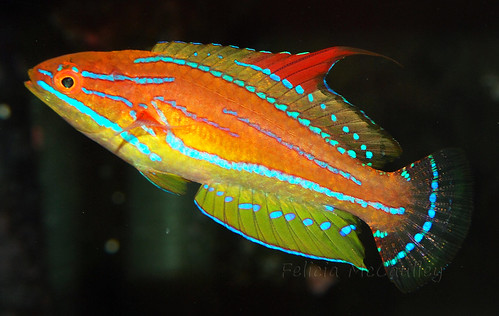
My yellow-fin flasher wrasse accidentally went over the overflow box and now lives in my seahorse tank. I'm not very good at catching fish, so he has stayed there. It's been a few weeks now, and my Rubriventralis fairy wrasse has turned into a male within that short time. "His" ventral fins are a gorgeous black-red color, and the blue on his tail and body glows. I promise to post better pictures soon.

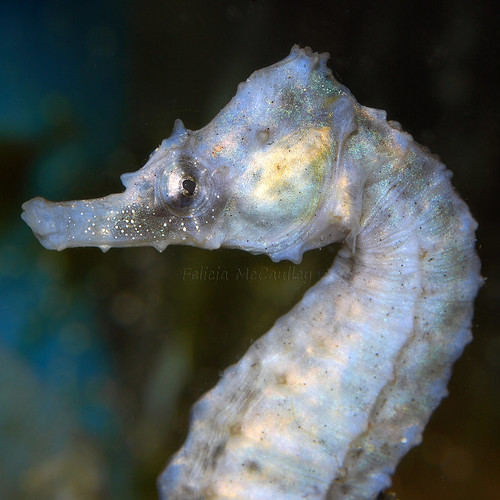
White Seahorse

The Erectus seahorses are also doing great. They are growing so big! It's hard to believe that just five months ago, they were tiny juveniles, only a few inches tall. I love this picture of Hoover, who is usually black. She turns white when I feed her or when she is being courted by Juniper or Debelius. Click on the photo for more detail.

The one-eyed goby my friend Paul got me for my birthday in April has finally started to gain some weight. Well, technically, he has two eyes, but one is severely deformed. When I first got him, I was concerned that he wasn't eating enough because he can't see anything on his right side. I try to target feed him, but if the food falls to his right side, he can't see it at all. He is less shy now and is confident enough to compensate for his eyesight by swimming in circles to look around.

Honestly, I'm surprised that my Crinoid feather star is still alive. All of its arms are intact, and it seems to be thriving. I put a fish net in my seahorse tank in an attempt to get the flasher wrasse used to it so I could catch him better. The Crinoid decided to make that fish net its home, so now I can't remove the net. The squat lobster is less shy now and is always visible on the center of the Crinoid. I'm noticing that the squat lobster doesn't steal small food particles from the Crinoid, only larger pieces (like Mysis) that fall and get stuck in its arms.

Lastly, one of my female Brotulids has slowly been getting fatter and fatter, till recently, her stomach turned dark and swollen. She definitely looked like the pregnant Brotulids I've seen before. The strange thing is that I don't have a male of the same species in the tank with her. She hasn't been around a male in almost a year. I'm not sure if they can store sperm the way that freshwater livebearers can, or if she possibly mated with the yellow Brotulid who is from a different genus and has radically different genitalia. Last week, I noticed that the front of her belly was flat, and a long black shape was still visible near her vent. The next day, it too was gone, and she now looks exactly like her sister. These fish are so ridiculously cryptic, I can only view the adults with a small flashlight I keep near the tank. Most people who buy Brotulids for their aquariums never see them again, or see them years later when they tear down their tanks. I can't help but wonder if I now have a couple baby Brotulids...

Aug 4, 2009

Almost Finished Renovations

I finally finished moving my aquariums around the kitchen. The 55 gallon with the 20 gallon sump is now home to all the reef fish, inverts, non-photosynthetic corals, and seahorses. The 25 gallon nano bullet tank is now a coral-only tank. The 37 gallon, which used to be the seahorse tank, is now a planted guppy and Limia tank. I usually go to bed pretty early, but some night I'll try to stay up past dark and get a shot of all three tanks with the lights off in the kitchen so you don't have to look at my refrigerator.

Allogalathea on Crinoid

I had to combine the two saltwater tanks and was nervous at first about how everyone would get along. So far, there haven't been any major problems. There was a squat lobster confrontation, however, on the first day. Darth Maul, the Galathea inflata, evicted Darth Vader, the Allogalathea elegans, from its favorite black Crinoid. In the wild, Darth Vader would have been eaten immediately without the protection of a Crinoid. So it felt that it had to move quickly to the nearest Crinoid, which happened to be my newest Crinoid, a purple one. It was obvious that Darth Vader did not like the purple Crinoid much, because it made its way to the nearest uninhabited black Crinoid soon after. Darth Maul, the Galathea inflata, does not live on the center of the Crinoid like Darth Vader does. Instead, it stands on the rock underneath the Crinoid's outstretched arms.

Purple Crinoid

What I found interesting is that the short, tufted antennae on either side of its rostrum were pointed toward the Crinoid the whole time it was travelling toward it. I wonder if commensal squat lobsters use those to chemically sense, or smell Crinoids. I wish I knew what those little antennae, circled in red on the picture at left, were called.

Pink Zoas

I found this pretty Zoanthus gigantus rock at my local store. Since I was good at the doctor and didn't hit the anesthesiologist this time, my husband let me buy it. For this photo, I tried out my new surface viewer while the coral was in acclimation. I think it turned out pretty well.

The light fixture I won from a raffle is kind of broken. Only some of the bulbs light up now. That's ok, since this is a non-photosynthetic tank now, and the hair algae is dying. Both the actinics light up, which looks pretty nice. Here's my sea cucumber under actinic lighting. It's still doing well and eats phytoplankton every day. It's difficult to tell since they change shape so much, but I think it has grown. It definitely hasn't gotten smaller. You can also see in the photo a small, white tuft coming out around the mouth. Since taking this photo last week, it has grown into a regular sized feeding tentacle. I don't think the animal hasn't lost any tentacles, so I wonder why it's growing new ones.

Jul 22, 2009

Livebearing Marine Brotulids

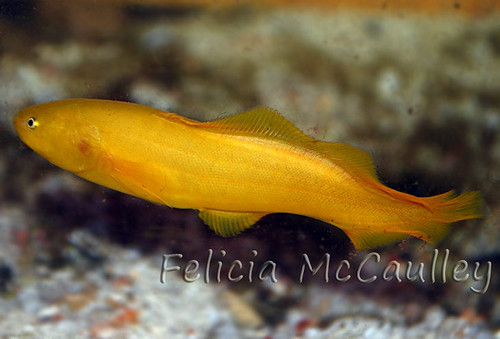
brotulid yellow eel goby

I've always been fascinated by livebearing fish like guppies, so when I discovered Brotulids, I had to know more about this odd, cryptic fish.

The most common species in the hobby is the yellow dusky Brotulid, otherwise known as a yellow eel goby. They're easy to care for and not picky eaters. They do best in small, peaceful aquariums with easily accessible places to hide, like PVC pipes and flowerpots. They should be target fed, since they are so shy. In large aquariums with a lot of rockwork, they can't be target fed and may starve.

I bought my first yellow dusky Brotulid in March 2008. I put him into my reef aquarium with over 90 pounds of live rock where he promptly dove under a rock pile never to be seen again. A few months later, I bought another one and put her in my seahorse aquarium which has low lighting and little live rock. She lives inside of a rock that is shaped like a cave. I can easily see her, but sometimes I have to use a small flashlight. She is almost constantly in movement, hovering inside her cave while undulating her beautiful, ribbon-like fins. She has become much less shy and even pokes most of the way out of her cave to eat thawed frozen mysis shrimp alongside my seahorses. She is not picky about what she eats and took to frozen food right away. She lives with my two female Orange Eel Gobies, which are a similar species. All three of them are very social with one another and share a cave. Strangely, they also share their cave with my Curious Wormfish, who is very similar to them in behavior and body shape. She is extremely peaceful and doesn't bother any of the small crustaceans or fish that share her tank. Even the squat lobster and Trimma gobies are safe with her.

Sexing this species of Brotulid is a little different than sexing other species. The males of most Brotulid species have large, visible claspers at the beginning of the anal fin. The male yellow Brotulid has a fleshy, crescent shaped pouch which contains his rounded claspers and sexual organs. The female (pictured here) is similar to females of other species in that they have a tiny "knob" at the front of the anus. Breeding this species in captivity might prove to be as easy as breeding freshwater livebearers. The young are large and highly developed when they are born. Unfortunately, there isn't a high demand for this cryptic species, so aquaculture facilities are not breeding them. There have been reports from hobbyists that some Brotulids eat bristleworms, which are a nuisance to aquarists. If this claim can be validated, that would make this species more popular with hobbyists.
These fish have gone by many scientific names including Dinematichthys riukiuensis, Brotulina fusca, and Diancistrus fuscus. No one is entirely sure which scientific name is valid for the little yellow Brotulids that sometimes show up in the aquarium trade. According to fishbase.org, Brotulina fusca is no longer a valid name, and is replaced by and a synonym of Diancistrus fuscus. Fishbase.org goes on to say that Brotulina fusca is very rare and known only from a single male specimen. It seems unlikely, but not impossible, to me that such a rare species would regularly make it into the aquarium trade. I think that these yellow Brotulids we see in the aquarium trade are more likely in the genus Dinematichthys. I recently came across this photo of a Dinematichthys randalli while doing a Google search. This is the closest I've ever come to positively identifiying my little Brotulid.

The best information I've found on these awesome fish so far has been from a German website called www.seahorsemania.eu. This is what they have to say (translated loosely into English):

"The following photos and info on the animal, comes courtesy of Martin Reith, Freiburg - www.seahorsemania.eu

This very unusual fish, Freiburg shop "Under Water" photographs, where several rare animals for sale. The Yellow bearded Brotulid is considered "Brotulina fusca" in the aquarium trade, but the current Latin name is Diancistrus fuscus. Hardly a rarity these aquarists will have ever seen, so a few additional details:

Assignment and kinship:

The Yellow bearded Brotulid is the family of livebearing Brotulas (Bythitidae) in order Ophidiiformes (like fish entrails / male-like beard) and is therefore associated with the widely-style cod (Gadiformes) related. Fishes of the order Ophidiiformes are mainly deep-water fish and this is also the reason why most divers and aquariums are not yet familiar with members of this order. The only members of this order, the little known, are the bizarre fish viscera (Family Carapidae) in the body of live sea cucumber.

In the family of livebearing Brotulas (Bythitidae) in addition to marine fish and a few representatives that live in anchialinen caves (caves where freshwater and saltwater mix). To mention are the genera Typhliasina, lucifuga and Ogilbia from cave systems in Central America as well as in various groups of islands in the western Atlantic and eastern Pacific. From the genus Diancistrus come here next to the imagined nature, even (still rare) reddish colored fish on the market. They are traded as Brotulina Erythrea, it could therefore possibly be Diancistrus erythraeus.


Verbreitung und Lebensraum:

The Yellow bearded Brotulid Diancistrus fuscus lives in the western Pacific in southern Japan, Taiwan and the northern half of the Philippines. To the south of the equator it is replaced by "Allen's bearded Brotulid" Diancistrus alleni. The Yellow bearded Brotulid was rarely observed free-living, it probably lived in shallow waters up to 20 meters in depth, well hidden in columns of coral reefs.


Posture and nutrition:

When it comes to attitude, we can only give rough recommendations because we have little experience with this species. For the welfare of the Yellow Bearded Brotulid in the aquarium, a large number of crevices and caves are needed, since the animals in nature predominantly reside in in columnar systems. Since the diet of these animals still as good as nothing is known, however, should first try to get these animals in a darkened aquarium with very little possibilities to keep hiding in order to be able to observe what food they take. The above-mentioned with the Yellow Beard related fish from anchialinen caves are known to eat several small crustaceans. Yellow Beard Brotulids may eat small copepods and Mysis shrimp. Pair or group housing would be recommended so that the very interesting reproductive behavior and the largely unknown social behavior can be observed.


Reproduction:

The animals are livebearing fish and have an internal fertilization. The males have in a belly fold a penis and pair of claspers similar to those of rays and sharks. The females live bring juveniles to the world. Perhaps Yellow Beard Brotulids are especially easy to breed.


Abstract:

The Yellow Bearded Brotulid is a rarely traded, and highly interesting from an unusual fish group, their way of life is still very little known. Even the exceptional reproduction suggests that the biologically interested aquarists, who is a Artbecken up a lot of sensational observations can be. The very hidden way of life make the Yellow Bearded Brotulid unsuitable for aquarium fish in their normal set, mixed reefs aquarists often want to see."

Mar 11, 2009

New seahorse video


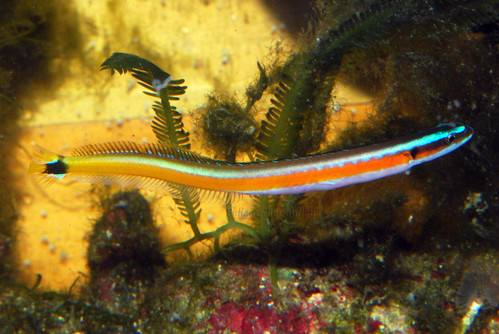
My seahorse aquarium with 3 juvenile seahorses, 2 adult seahorses, bluestriped pipefish, Trimma goby, red scooter dragonet, and squat lobster. The Brotulids are hiding, sorry.